
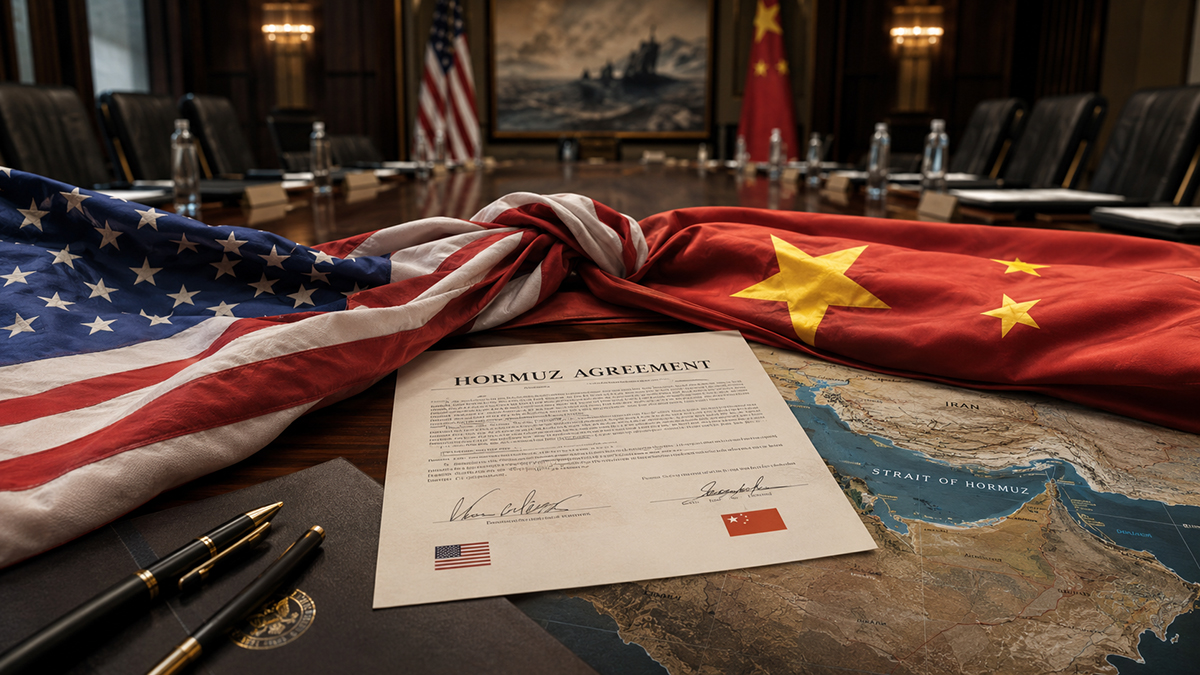
The Trump-Xi Beijing summit ended with a headline the market treated as marginally constructive for oil: both governments agreed the Strait of Hormuz must remain open. WTI settled near $100 and Brent near $105, down slightly from intraday highs but nowhere near the $70 level that prevailed before Iran's blockade began in late February. The S&P 500 rose 0.33% on the day. The Dow crossed 50,000. Nvidia jumped on confirmation that Jensen Huang joined the U.S. delegation to Beijing, raising expectations of renewed chip export access to China.
The TSX did not share in the enthusiasm. The composite closed down approximately 0.3%, pulled lower by a single earnings report that the morning's desks could not yet see.
The Manulife Miss Reveals a Compression the Market Has Not Fully Priced
Manulife reported Q1 2026 core EPS of CAD $0.7735 against a consensus of CAD $0.8036, a 3.75% negative surprise. The Asia segment performed strongly. The U.S. and Canadian operations did not. Net investment results declined 5% due to lower investment spreads in the U.S., a direct consequence of the rate environment Manulife cannot control.
The miss landed on a day when the TSX financial sector was already navigating cross-currents: higher energy prices that lift commodity names while compressing the discretionary spending and credit quality that underpin bank earnings. Manulife's stock fell approximately 5.7%, pulling the broader financial complex with it. MFC had reached an all-time high of CAD $54.83 on May 8. It was trading near CAD $38.26 in premarket. The gap between that high and today's close is a specific number that reflects a specific problem: Canadian lifecos are caught between the rate environment they need and the rate environment the economy is producing.
The chart above shows Manulife's Q1 core EPS trajectory against consensus estimates from Q1 2024 through Q1 2026, alongside the Bank of Canada policy rate over the same period. The compression in investment spreads tracks directly with the BoC's hold decisions across 2026.
The Q1 2026 EPS miss of 3.75% below consensus coincides with the BoC hold at 2.75%, which has compressed net investment spreads in Manulife's U.S. and Canadian segments since Q4 2025. The BoC rate step line shows the descent from 5.00% in 2024 to the current hold, with the hold zone shaded. Source: Manulife Q1 2026 earnings release; Bank of Canada rate decisions.
The Warsh Confirmation and the June Calendar Collision
The second thread the morning could not fully see: Kevin Warsh was confirmed as Federal Reserve chair Wednesday on a 54-45 vote, taking the most divisive confirmation in the modern Fed era. His first FOMC meeting is June 16-17. The Bank of Canada's next decision is June 4.
These two dates, twelve days apart, constitute a policy sequencing problem that the morning desks identified individually but could not connect. The Economy Desk established that the BoC is navigating a stagflation configuration: oil at $100+ is inflationary while the broader consumer and credit environment is softening. The Geopolitical Desk established that the Trump-Xi Hormuz agreement is a political signal, not an operational reopening; Chinese state media did not echo the Hormuz language in their readout of the summit, and the IEA confirmed that global inventories are depleting at a record pace regardless of diplomatic statements.
The connection: Warsh arrives at the Fed with a mandate to deliver lower rates from a president who wants them, in an economy where energy-driven inflation makes cuts difficult. His June 16-17 meeting will produce either a hold that validates the BoC's caution or a signal that increases pressure on Governor Macklem to respond. If Warsh holds, the BoC's June 4 decision was made in a vacuum. If Warsh signals cuts despite inflation, the BoC faces a policy credibility question it has not had to answer since 2022.
The chart above shows the Federal Reserve and Bank of Canada rate paths from January 2024 through today, with the June 4 BoC meeting and June 16-17 Warsh FOMC meeting marked, and the current oil price overlay that is reshaping both decisions simultaneously.
The Fed-BoC spread has widened to approximately 163 basis points, the largest gap since 2007. Warsh's June 16-17 FOMC meeting arrives twelve days after the BoC's June 4 decision, creating a sequencing problem: the BoC will set policy before knowing Warsh's direction. The BoC neutral rate reference at 2.50% shows that current policy is just 25 basis points above neutral with inflation still elevated by energy costs. Source: Federal Reserve, Bank of Canada.
What Tomorrow Morning Looks Like
The advisors who read the morning's five desks had a coherent picture of the day's risks at 10 AM. By close, that picture has been complicated in two specific ways.
First, the Hormuz "agreement" is not an operational reopening. The IEA confirmed Wednesday that supply losses from the strait are depleting global inventories at a record pace. Chinese state media did not mention Hormuz in their readout of the summit. Treasury Secretary Scott Bessent said China will work "behind the scenes" using its leverage over Iran, which is a diplomatic process, not a market event. WTI at $100 is the equilibrium the market has accepted for now, not a number that has priced in a resolution. Canadian energy names are appropriately supported at these levels. The risk is not that oil falls sharply; the risk is that the market's current reading of Hormuz as "improving" is premature, and a further deterioration in global inventory data reprices the inflation expectation that Warsh will face at his June meeting.
Second, Manulife's miss is not idiosyncratic. The pressure on MFC's investment spreads is the same pressure sitting on the earnings of every Canadian lifeco and, to a lesser degree, every Canadian bank that holds duration. The BoC is at 2.75%, 25 basis points above its own neutral rate estimate of 2.50%. If the June 4 decision is a hold, it is a hold taken with oil at $100+ driving inflation and with Warsh's June 16-17 debut setting the U.S. rate context twelve days later. That is not a comfortable position for Macklem, and it is not a neutral outcome for the clients whose bond portfolios and mortgage rates are priced off the Government of Canada five-year yield.
The Behavioral Desk's morning framework named the risk of recency bias in a market that has adapted to $100 oil as a new normal. The Daily Thread's closing read: that adaptation is the risk, not the comfort. The advisors who are telling clients that high oil is "priced in" are correct about today. They may be early about June.