
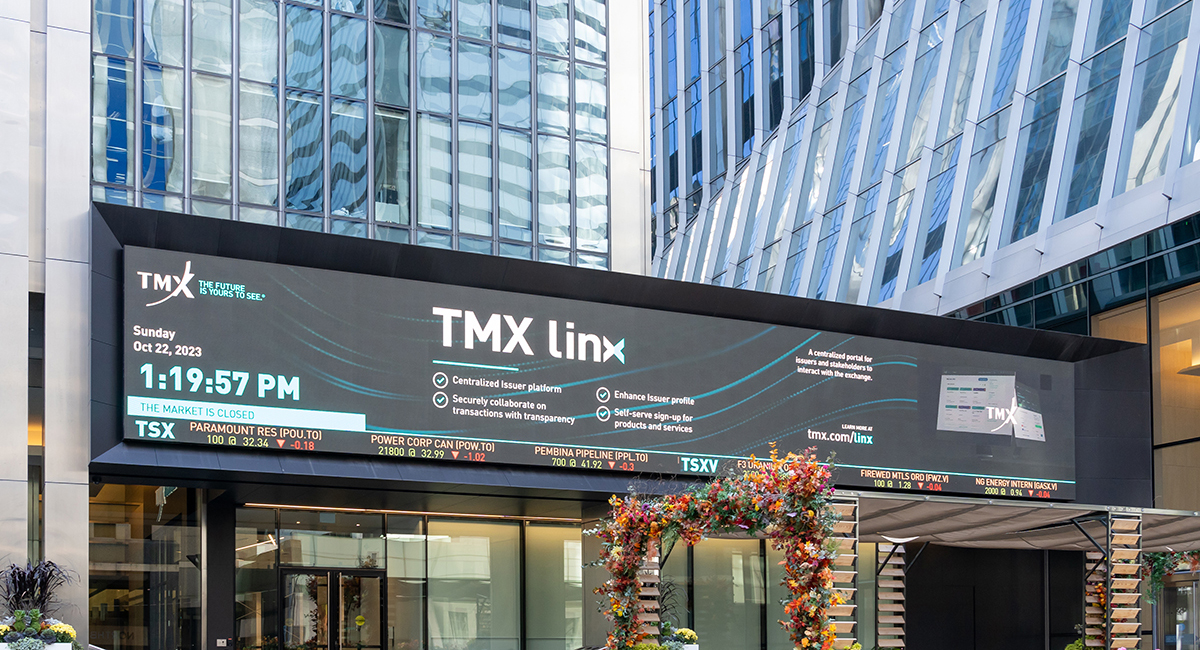
The TSX shed 471 points Tuesday, closing at approximately 34,000 after opening the week at a multi-month high near 34,830. The proximate cause was U.S. military strikes in southern Iran, which arrived even as President Trump posted that peace negotiations were progressing. The contradiction between the military action and the diplomatic messaging was precisely the kind of unresolvable ambiguity that drives markets lower: not a clear escalation, not a clear resolution, but an environment where neither can be priced out.
Wednesday morning opened at 34,027, essentially flat from Tuesday's close, with bank earnings providing a counterweight to geopolitical pressure. BMO and Scotiabank both beat estimates before the open, with adjusted EPS of $3.67 and $2.02 respectively against consensus of $3.45 and $1.73. The question for the session is whether earnings strength can hold the index against Hormuz-driven risk-off pressure, or whether Tuesday's repricing of the resolution timeline dominates.
Energy and Gold: The Sector-Level Read
The energy sector's Tuesday performance was counterintuitive at the index level but coherent at the commodity level. WTI fell 5.1% to $91.73 even as Brent rose 2% to $98.26. Canadian producers price off WTI-linked Western Canadian Select, which means Tuesday's commodity move was negative for Canadian energy revenue despite the headline Brent number suggesting otherwise. Suncor, Canadian Natural Resources, and Cenovus all declined as a result.
Gold miners fell alongside energy for a different reason. Monday's peace rally had pushed gold lower as safe-haven demand faded. Tuesday's reversal partially restored the safe-haven bid, but the intraday volatility produced net selling across the mining complex as investors who had added gold exposure on the Hormuz thesis took profits rather than ride another whipsaw. Agnico Eagle fell 1.7%, Barrick lost 1%, and Wheaton Precious Metals declined 2.6%.
The chart above shows the TSX composite daily closes against the TSX Energy and TSX Materials sub-indexes from May 1 through May 27, illustrating the sector divergence during the ceasefire-trade cycle and its reversal.
The TSX touched approximately 34,830 on Monday May 25 on peace-deal optimism before Tuesday's 471-point reversal on U.S. military strikes; Wednesday opened at 34,027, essentially flat, with bank earnings providing partial support against continued Hormuz uncertainty.
Banks vs. Geopolitics: The Wednesday Setup
The morning's earnings results from BMO and Scotiabank are substantively strong. BMO's adjusted EPS of $3.67 beat the $3.45 consensus on the back of a 47% surge in Capital Markets earnings and 15% growth in Canadian personal and commercial banking. Scotiabank's net income of $2.63 billion, up 30% year-over-year, reflected double-digit pre-tax pre-provision growth in Canadian Banking and expanding margins.
Both results point to an underlying Canadian financial sector that is performing well on the fundamentals: credit quality has improved, wealth management fee revenue is growing as clients seek advice in uncertain conditions, and capital ratios remain strong. BMO's CET1 ratio stands at 13.5% on an adjusted basis; Scotiabank's CET1 improved 30 basis points to 13.2%.
The tension for Wednesday's session is whether strong bank earnings can provide enough lift to offset the geopolitical overhang, or whether the Hormuz repricing that drove Tuesday's 471-point drop is the dominant factor. The opening print at 34,027, essentially flat from Tuesday's close, suggests the market is treating the two forces as roughly offsetting at the open. RBC reports Thursday and TD reports later in the week, which means earnings support extends into the back half of the week regardless of how Hormuz develops.
CAD and the Rate Path
The Canadian dollar at 72.37 cents U.S. is near levels that compound the inflation problem the Bank of Canada is already managing. A weaker CAD means imported goods cost more in Canadian dollar terms, which adds a second layer of inflationary pressure on top of the energy shock. The BoC's April MPR projected 1.2% GDP growth for 2026, already a modest pace; currency weakness adds to the stagflationary risk profile by pushing inflation higher without any corresponding improvement in growth.
The June 10 decision is now carrying more weight than a typical hold would. If the BoC's statement language shifts toward acknowledging that the energy-driven inflation spike is proving more persistent than assumed, GoC 5-year yields move higher, fixed mortgage rates follow, and the 2026-2027 renewal wall becomes materially more difficult for the cohort of households renewing at above-contract rates.