
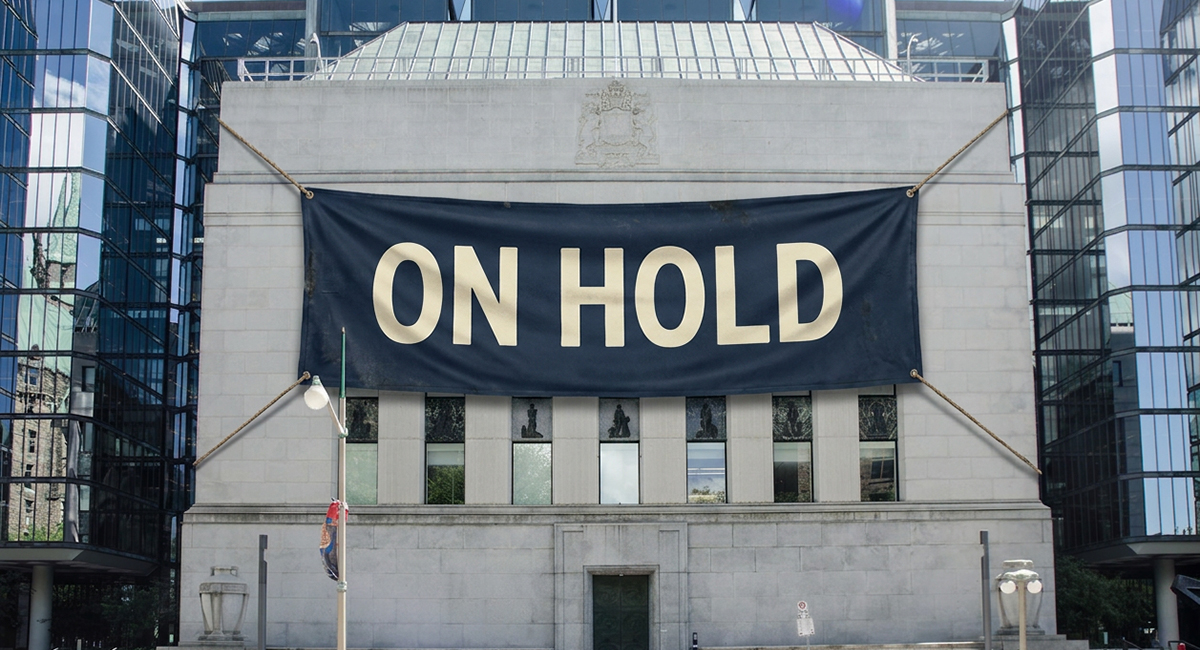
The Bank of Canada's decision to hold its overnight rate at 2.25% for the seventh consecutive time produces no headline. No cut, no hike. Markets had priced near-certainty of a hold since May's extraordinary jobs report added 88,000 positions against a 10,000 consensus, and a hold is exactly what they got. Nothing happened. That is the problem for a large number of Canadian mortgage holders who will use that fact as permission to do nothing themselves.
What Status Quo Bias Actually Does
William Samuelson and Richard Zeckhauser identified status quo bias in 1988 in a paper published in the Journal of Risk and Uncertainty. Their finding, replicated across investment decisions, insurance choices, retirement allocations, and consumer contracts ever since, is that people systematically prefer whatever the current state is, even when the alternative is measurably better. The preference is not about the merits of the options. It is about the psychological cost of change.
The mechanism is loss aversion, Kahneman and Tversky's foundational finding from 1979. Switching from one mortgage lender to another, or from a fixed rate to a variable, or from a shorter term to a longer one, requires the holder to mentally account for what they are giving up. Because losses loom larger than equivalent gains, the perceived cost of switching always feels larger than the perceived benefit, even when a spreadsheet shows otherwise. The status quo 'wins' not because it is better but because it is current.
Richard Thaler extended this analysis in his 2008 book 'Nudge' through the concept of default rules: people tend to accept whatever option requires no action to accept. In the mortgage context, the default is the renewal offer from the existing lender. Accepting it requires no paperwork, no credit pull, no calls to other institutions. It is the path of least resistance. Thaler's research shows that default acceptance rates exceed 80% in many financial product contexts, even when alternatives are superior.
The 2026 Renewal Environment
Canada's mortgage renewal volume in 2026 is without historical precedent in scale. Approximately 30% of all outstanding Canadian mortgages are renewing this year, concentrated among borrowers who took five-year fixed terms at pandemic-era rates in 2021. Those borrowers locked in at rates that averaged around 1.9% to 2.2%. The Government of Canada five-year bond yield, which drives fixed-rate mortgage pricing, closed at 3.15% on June 9. Lenders apply a spread of approximately 120 to 180 basis points above that benchmark, which places current five-year fixed renewal rates in the 4.35% to 4.95% range.
The math is not subtle. A client who borrowed $600,000 at 2.0% in 2021 with a 25-year amortization paid approximately $2,543 per month. The same remaining balance renewed at 4.5% produces a payment of roughly $3,268 per month, a jump of $725. Spread across the renewal term, that is $43,500 more paid over five years before any comparison of lender rates is factored in.
Equifax Canada estimated earlier this year that nearly one-quarter of renewing mortgage holders will face higher payments in 2026 as pandemic-era contracts reset. That population is exactly where status quo bias is most expensive. Because rates have held, because no crisis has emerged, because the news contains no obvious trigger for urgency, many of those clients will accept the first offer they receive.
The Invisible Cost Advisor
The behavioral finance insight here is precise: status quo bias does not produce bad decisions in environments that are clearly alarming. It produces bad decisions in environments that feel stable. A client facing a collapsing market, a rate spike, or a personal financial shock will often take action. A client renewing into a rate environment that feels unremarkable will often not. The seven consecutive Bank of Canada holds have created exactly the flat psychological backdrop in which the bias operates most freely.
Barber and Odean's 2000 study in the Journal of Finance documented the cost of investor inertia through thousands of brokerage accounts, finding that the least active traders outperformed the most active on a net basis. But that finding addresses trading decisions. Mortgage renewal is the inverse scenario: here, action is what outperforms. The client who compares lenders, who contacts a broker, who asks whether their rate reflects their current credit profile and income, frequently renews at a meaningfully lower rate than the client who accepts the first offer. The advisor who makes that case explicitly, before the default takes hold, is performing a measurable service.
The GoC five-year yield has risen 20 basis points over the past year, reaching 3.15% on June 9, even as the Bank of Canada has held the overnight rate unchanged since December 2025. Fixed mortgage renewal rates, which trail this benchmark by a lender spread of 120 to 180 basis points, have risen accordingly.
The GoC five-year bond yield has tracked above 3.00% since October 2025 and closed at 3.15% on June 9. That is 20 basis points higher than a year ago, a move that has pushed fixed renewal rates to levels most renewing clients have not encountered before. The hold at 2.25% does not mean the renewal environment is benign. It means the overnight rate is stable while the five-year yield, which is what drives fixed mortgage pricing, has already moved.
Why Stability Is the Most Dangerous Environment
Shefrin and Statman's 1985 paper in the Journal of Finance on what they called the disposition effect documented the systematic tendency to hold losing positions too long and sell winning positions too early, a pattern driven by the same loss-aversion mechanism that produces status quo bias. The common thread is avoidance of regret. Selling a winner produces the regret of leaving money on the table. Holding a loser avoids the regret of crystallizing a loss. Staying with the existing mortgage lender avoids the regret of going through a comparison process and possibly not finding a better offer.
This is the architecture of the problem. The client who accepts the renewal offer from their existing lender without shopping alternatives has not made a rational calculation. They have made a default choice dressed up as a rational one. The advisor's role is to make that visible. Not to prescribe what the client should do, but to make the cost of not asking the question explicit before the envelope gets opened.
The July 15 Bank of Canada decision is the next potential catalyst. If the May CPI print, due June 22, shows continued energy-driven elevation, rate-hike pricing will build modestly in financial markets, as it has already begun to with roughly 40 basis points of hikes priced into swaps by year end according to Bloomberg data. But that is a market expectation, not a certainty, and waiting for certainty is itself a form of status quo bias. The clients renewing in July through September do not have until July 15 to decide.