
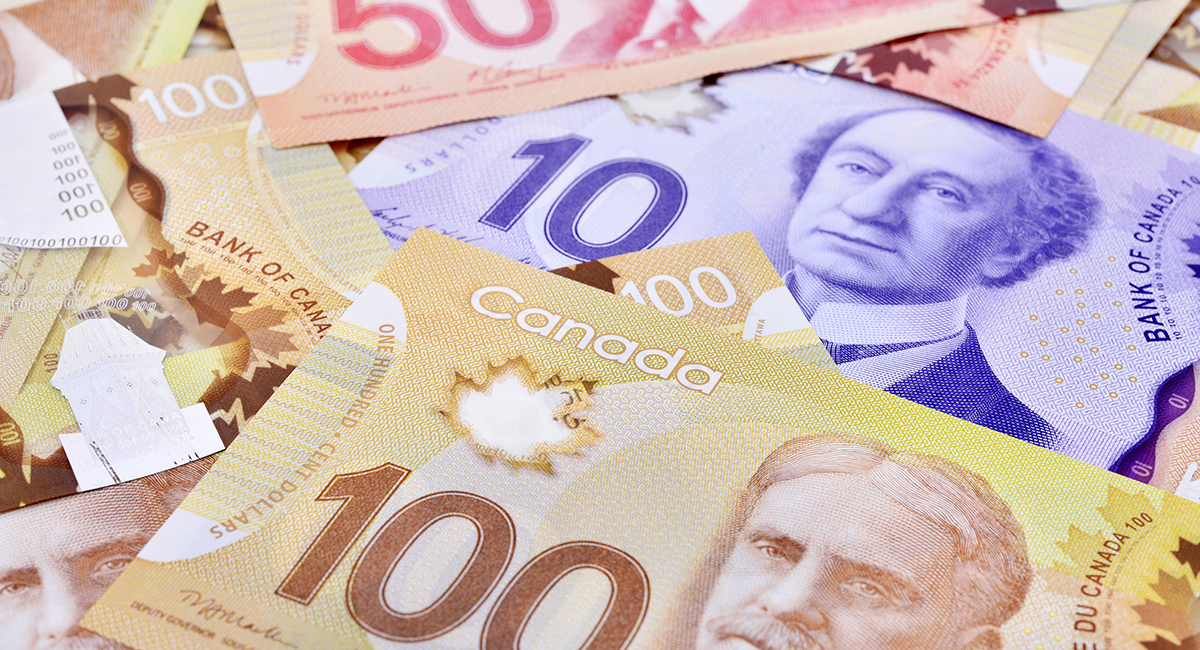
The Canadian dollar weakened to $1.4167 per US dollar on June 22, its softest level in fourteen months, as the Federal Reserve's hawkish June dot plot under new Chair Kevin Warsh widened the gap with the Bank of Canada's hold at 2.25%. The US dollar has gained against the Canadian dollar in nine of the last ten trading sessions. For Canadian investors holding US equities, that move has been doing quiet work in the background of returns, and the consequences land very differently depending on which account the position sits in.
The Hedging Decision Looks Different Than It Did in May
Currency-hedged and unhedged versions of the same US equity exposure produced nearly identical returns through most of the first half of the year. The Canadian dollar averaged $1.3787 per US dollar in January and was still averaging $1.3718 in May, a range of less than one cent. The move since then has been sharper and more one directional: the dollar climbed from $1.3944 on June 10 to $1.4167 on June 22, a gain of more than 1.5% in two weeks, almost all of it arriving after the Fed's June 17 dot plot.
An unhedged US equity holding has picked up that currency move on top of whatever the underlying stocks did. A hedged version of the identical fund has not. Neither choice is wrong on its own terms. The point worth raising in a planning conversation is that the gap between the two has only recently become large enough to matter, and the direction of the next move depends heavily on what the Bank of Canada does at its July 15 decision.
The path below tracks the US dollar's climb against the Canadian dollar from a fourteen-month low in early 2026 to this week's high, with the steepest portion of the move concentrated in the two weeks since the Fed's dot plot.
Monthly averages are used for January through May to smooth daily noise; June is shown daily to isolate the move around the Fed's June 17 decision. Source: X-Rates monthly averages, MTFX daily rates.
RRSP and RRIF: The Treaty Exemption Still Does the Work
US dividends paid into an RRSP or a RRIF are exempt from US non-resident withholding tax under the Canada-US Tax Treaty, provided the holding is registered correctly with the custodian. That exemption applies whether the underlying exposure is hedged or unhedged, and it makes the RRSP and RRIF the most tax-efficient home for US dividend-paying equities or ETFs in a Canadian household, independent of any view on the currency. The decision inside these accounts is a volatility and asset-mix question, not a withholding tax question.
TFSA: No Treaty Protection, and No Credit to Recover It
The treaty exemption does not extend to the TFSA. US-source dividends paid into a TFSA are subject to the standard 15% non-resident withholding tax, deducted by the custodian before the dividend is credited to the account. Because TFSA income is not reported on a Canadian tax return, there is no foreign tax credit mechanism available to recover that 15%, and the loss is permanent. A US dividend-paying ETF held inside a TFSA gives up a flat 15% of its dividend yield every year for the life of the holding, a cost that does not show up anywhere on a statement and rarely comes up unless an advisor raises it directly.
Non-Registered Accounts: The Same 15%, Recoverable This Time
A non-registered account faces the identical 15% US withholding tax on the same dividend, but the outcome is different because the income is reported on the investor's Canadian tax return. The foreign tax credit allows that 15% to be claimed against Canadian tax otherwise owing on the same income, up to the limit of that Canadian tax liability, which converts a cost that is permanent inside a TFSA into one that is largely recoverable inside a non-registered account.
The practical conclusion follows directly from the account mechanics rather than from any forecast of where the Canadian dollar goes next. A household holding US dividend-paying equities across RRSP, TFSA, and non-registered accounts should generally fill the RRSP first, the non-registered account second, and the TFSA last, reserving the TFSA for Canadian holdings or non-dividend-paying growth positions where the withholding tax does not apply.
The Bank of Canada's July 15 decision is the next point at which this calculus could shift again. A second consecutive hold against a Fed that has already moved would extend the policy gap behind this year's currency move. A reason to revisit the hedging decision, on either side, would be a change in either bank's path, not a change in the account rules that determine where the tax drag actually falls.