
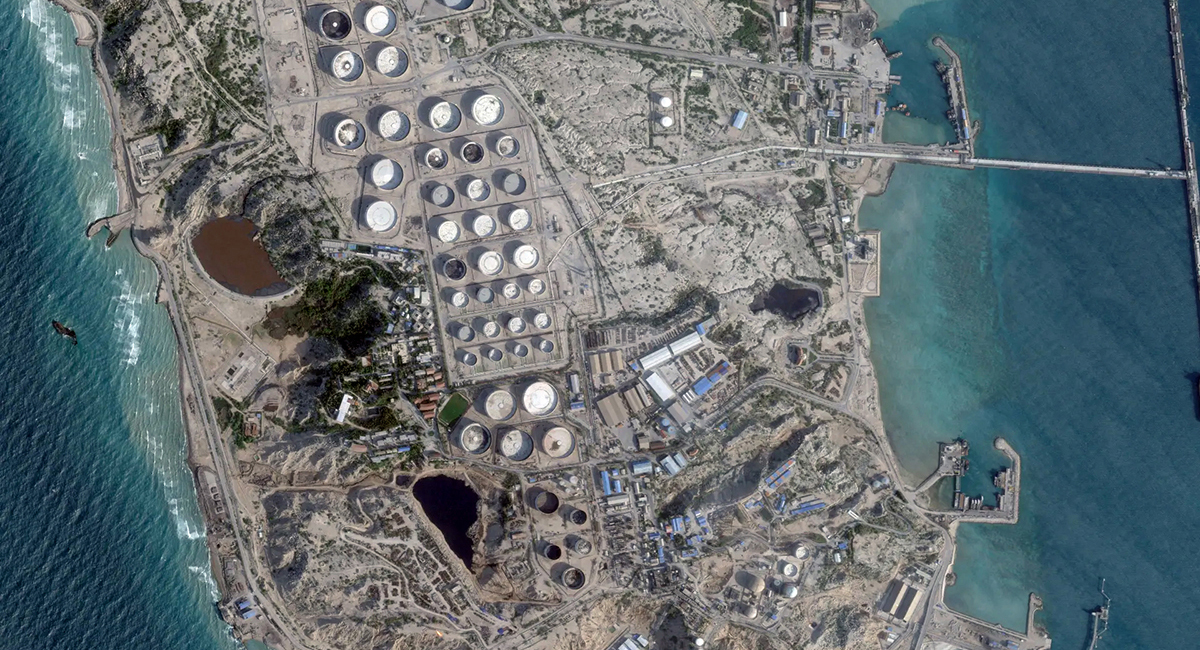
This week marks the fourth time since March that President Trump has raised the prospect of striking Iran's oil export infrastructure on Kharg Island directly, after U.S. Central Command disabled a tanker headed for the island Wednesday, the first vessel intercepted under the reinstated naval blockade. Each prior threat has been followed by a walk-back or a strike that deliberately spared the oil facilities. The question for Canadian portfolios is not whether this week's version is the one that follows through, which is not knowable in advance, but what actually changes in the event that it does.
What Kharg Island Actually Handles
Kharg Island is a five-mile coral outcrop in the northern Persian Gulf that has been Iran's primary oil export hub for nearly seven decades. Roughly 90 per cent of the country's crude exports move through it, close to 950 million barrels a year, with a loading capacity of about seven million barrels a day even though actual current throughput runs closer to 1.5 million. Offshore fields feed the island through underwater pipelines, and its storage tanks hold roughly 18 million of a possible 30 million barrels of capacity, according to trade intelligence firm Kpler. Most of the crude that leaves Kharg is bound for Asia, predominantly China.
Transit Risk Resolves. Production Risk Does Not.
Every escalation in this conflict since February has centred on transit risk: tanker attacks, naval blockades, and closures of the Strait of Hormuz that disrupt shipping but leave Iran's underlying export capacity intact. That kind of disruption resolves when a blockade lifts or a ceasefire holds, as it has three times already. A direct strike on Kharg's oil infrastructure is a different category of event. JPMorgan data shows a hit on the terminal would instantly remove roughly 1.5 million barrels a day of Iranian exports, and analysts have noted that rebuilding destroyed infrastructure would take years, not weeks. Iran's alternatives are limited. The Goreh-to-Jask pipeline can bypass both Kharg and Hormuz but caps out around 1.5 million barrels a day, and the International Energy Agency does not consider the smaller Jask terminal a viable large-scale export option. A Kharg strike would not simply interrupt Iranian exports. It would remove most of them for an extended period, with no comparable substitute waiting in reserve.
The Buffer Is Thinner This Time
A blog post from the International Monetary Fund published Wednesday flagged a mechanism worth watching closely. Between March and May, global strategic crude stockpiles absorbed a deficit of roughly four million barrels a day, cushioning what would otherwise have been a sharper price shock when the conflict first erupted. That buffer has been drawn down since, and the IMF's own assessment is that the world no longer has the same cushion available if a fresh disruption hits. A Kharg-scale shock landing on a shallower reserve base would be expected to move price further and faster than the initial disruption did in February and March.
What's Already Priced, and What Isn't
Oil-linked assets have repriced sharply since the ceasefire began unravelling on July 7, while equities, gold and the currency most exposed to the story have barely moved over the same window, a gap visible when the assets most tied to the Hormuz mechanism are compared side by side.
WTI and Brent have moved more than 13 per cent since the ceasefire began unravelling. The Canadian dollar, government bond yields, the TSX and gold have moved a fraction of that, evidence the broader market is treating this as an energy-specific story rather than a systemic one.
Base Case Versus Tail Risk
The base case remains that Kharg's oil infrastructure stays untouched, consistent with the pattern of every prior threat, with Washington continuing to apply pressure through the naval blockade and strikes on military targets rather than the export terminal itself. The tail risk, which current oil pricing already partly reflects, is a direct hit on the terminal, which would remove Iranian export capacity for years rather than weeks and land on a strategic reserve buffer that the IMF itself has flagged as thinner than it was in March. For Canadian portfolios, the near-term exposure runs through WTI-linked energy names and the currency. The tail-risk exposure runs through how much further oil can move if the one asset class that has not yet repriced, everything outside energy, is forced to catch up.