
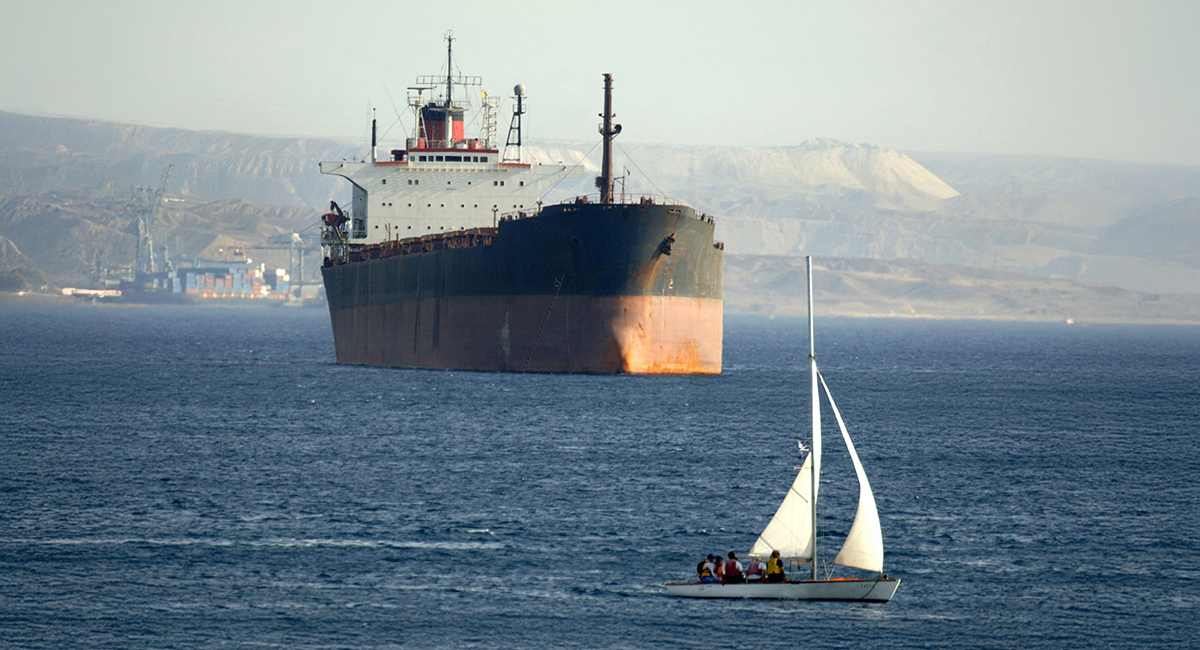
Yemen's Houthi rebels declared a maritime blockade of Saudi Arabia this week and have deployed missiles and drones near the Bab el-Mandeb Strait, the narrow passage linking the Red Sea to the Gulf of Aden. At least seven tankers carrying Saudi crude have already turned back rather than transit the strait, and the European Union's Aspides naval force raised its threat assessment for the waterway from low to medium on Wednesday. Vessel traffic through Bab el-Mandeb fell 34% Tuesday compared with the day before, according to ship-tracking firm Kpler.
The mechanism connecting this to Canadian portfolios starts with a fact that has nothing to do with the Houthis directly.
Why This Route Suddenly Matters So Much
Saudi Arabia has spent this year quietly rerouting a growing share of its crude exports through Bab el-Mandeb specifically to avoid the war-risk premium and physical danger building in the Strait of Hormuz, where Iran has stepped up attacks on tankers off Oman and the United Arab Emirates this week. Saudi crude moving through Bab el-Mandeb reached 3.5 million barrels a day in June, up from just 240,000 barrels a day in the same month a year earlier. The workaround became the primary route. Now the workaround is under threat too.
This is not a story about one chokepoint. It is a story about the disappearance of the alternative to the chokepoint everyone was already worried about. Hormuz carries roughly a fifth of global oil consumption on its own; Bab el-Mandeb had become the pressure valve that let Gulf producers keep barrels moving while Hormuz stayed dangerous. A threat to both at once removes the redundancy that had been quietly capping how seriously markets had to take either one.
Tail Risk Versus Base Case
The base case so far is a self-selecting decline in traffic, not a physical closure. Ships are rerouting around the Cape of Good Hope or diverting to the Suez Canal because owners and insurers are choosing caution, the same pattern seen when Bab el-Mandeb transits fell from more than 70 vessels a day before 2023 to roughly 28 a day during the 2025 Houthi campaign, without the strait ever being formally shut. That decline alone is enough to tighten effective shipping capacity and firm the floor under freight and insurance costs.
Wednesday's cross-asset moves show where the risk actually landed, WTI and gold both up more than two per cent while the Nasdaq slipped, a split that says the market is pricing a commodity story, not yet a broad growth scare.
Percentage changes reflect same-session moves for each asset and are not directly comparable in scale, WTI and gold trade in dollar terms while the TSX and Nasdaq are index points. Source: The Canadian Press, Yahoo Finance.
The tail risk is a successful strike on a laden tanker rather than a near miss. Two Greek dry bulk carriers sank during the Houthis' 2025 campaign, and a repeat this cycle would harden war-risk insurance premiums sharply and could constrain physical flows for weeks rather than days. That scenario is not the base case today, but it is the scenario that would turn a pricing story into a supply story.
What It Means for Canadian Energy
WTI closed Wednesday at $86.95, its highest level in more than five weeks, and Canadian producers including Suncor, Canadian Natural Resources and Cenovus have gained on the combined Hormuz and Red Sea risk this week. The asymmetry HDQ has flagged before still applies: realized prices benefit from the premium, but the premium's durability depends on a security situation rather than a supply-demand fundamental. It does not require either chokepoint to actually close. It only requires both to look uncertain at the same time, which is precisely where things stand today.