
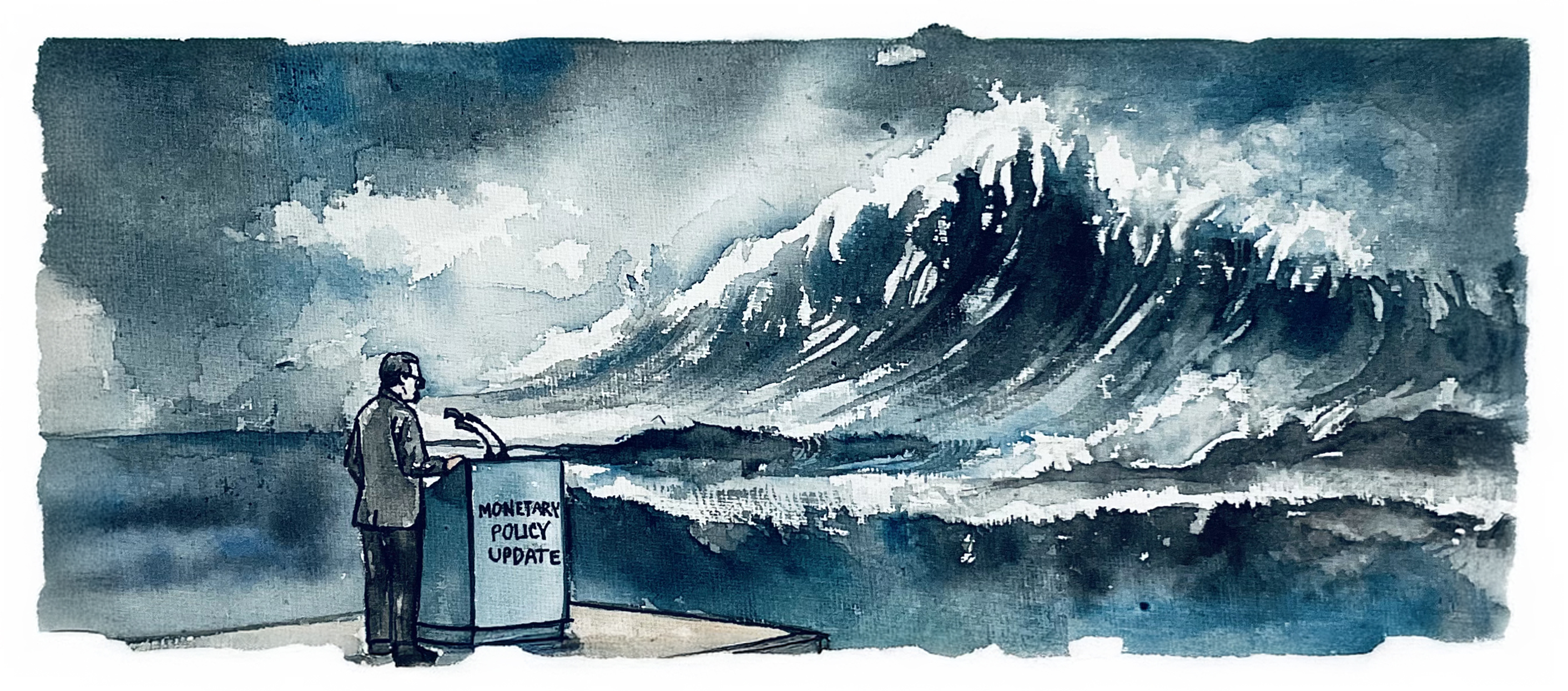
Four trading sessions this week, Labour Day closed markets Monday, produced almost every kind of shock a bond market should react to: a global rates selloff, a hawkish Bank of Canada hold, a second wave of strikes in the Iran conflict, and a dovish comment from a U.S. Federal Reserve governor. The Government of Canada 10-year yield barely moved through any of it. It took a Canadian jobs report on Friday to do what three days of geopolitical and central-bank news could not.
Three Shocks, One Yield That Held Its Ground
Tuesday''s session opened with the GoC 10-year at 3.75 percent, its highest level since August 20, driven by a global bond selloff rather than anything domestic. The TSX composite slipped to 35,978.00, a four-week low, even as WTI crude rose 2.6 percent on renewed Strait of Hormuz risk.
Wednesday, the Bank of Canada held its policy rate at 2.25 percent for a seventh consecutive meeting and flagged rising inflation risk from tariffs and energy prices, language hawkish enough to push the 10-year to 3.80 percent, a two-year high. The move from Tuesday''s level was five basis points on a statement built to sound alarmed.
Thursday, Federal Reserve Governor Christopher Waller said he would be inclined to hold rates steady barring a surprise in inflation data. The comment pulled September hike odds down and rallied the TSX 1.3 percent, roughly 458 points, to close near 36,549.61. The Government of Canada 10-year moved less than one basis point, settling at 3.79 percent. Two governments, one war, and a full percentage point of implied urgency in the headlines, and the number that actually prices a five-year mortgage renewal had gone nowhere in three days.
Then Friday''s Jobs Numbers Did What the Rest of the Week Could Not
Statistics Canada and the U.S. Bureau of Labor Statistics released August employment reports within minutes of each other Friday morning. Canada shed 41,700 jobs against a consensus call for a 15,000 gain. The United States added 162,000 against an expected 53,000. For the first time all week, the Government of Canada and U.S. 10-year yields moved in opposite directions.
The TSX still closed higher, up 10.72 points to 36,560.33, because the same report that delivered the headline miss also weakened the Canadian dollar toward 1.386 per U.S. dollar, and manufacturing, the one sector that actually grew in August at plus 22,000 jobs, is also the sector most directly helped by a softer loonie. The damage and the offset arrived in the same release.
The TSX composite gained ground every session this week while the Government of Canada 10-year yield stayed within five basis points of where it started, a gap that only closed once Friday''s jobs data arrived.
The TSX composite gained 1.62 percent across the week''s four trading sessions while the Government of Canada 10-year yield moved only five basis points through Thursday, before Friday''s jobs data reset the divergence. Source: Baystreet.ca, TMX Group, Bank of Canada, Sep 4, 2026.
What a Four-Session Week Says About the Next BoC Decision
The lesson from the week is not that Canadian yields are sticky. It is that they are selectively sticky. A war escalation, a hawkish central bank statement, and a foreign policymaker''s comment all failed to move the number that matters most for a mortgage renewal. A domestic labour market report that missed by 56,700 jobs against consensus moved it immediately.
That distinction matters heading into the Bank of Canada''s next decision. Wednesday''s statement was built on inflation risk. Friday''s data reopened the question of whether the labour market can bear that stance much longer. An advisor fielding client questions about the BoC''s path should treat this week as evidence that geopolitical headlines and hawkish rhetoric are not what is moving the curve right now. A second soft jobs print would be.