
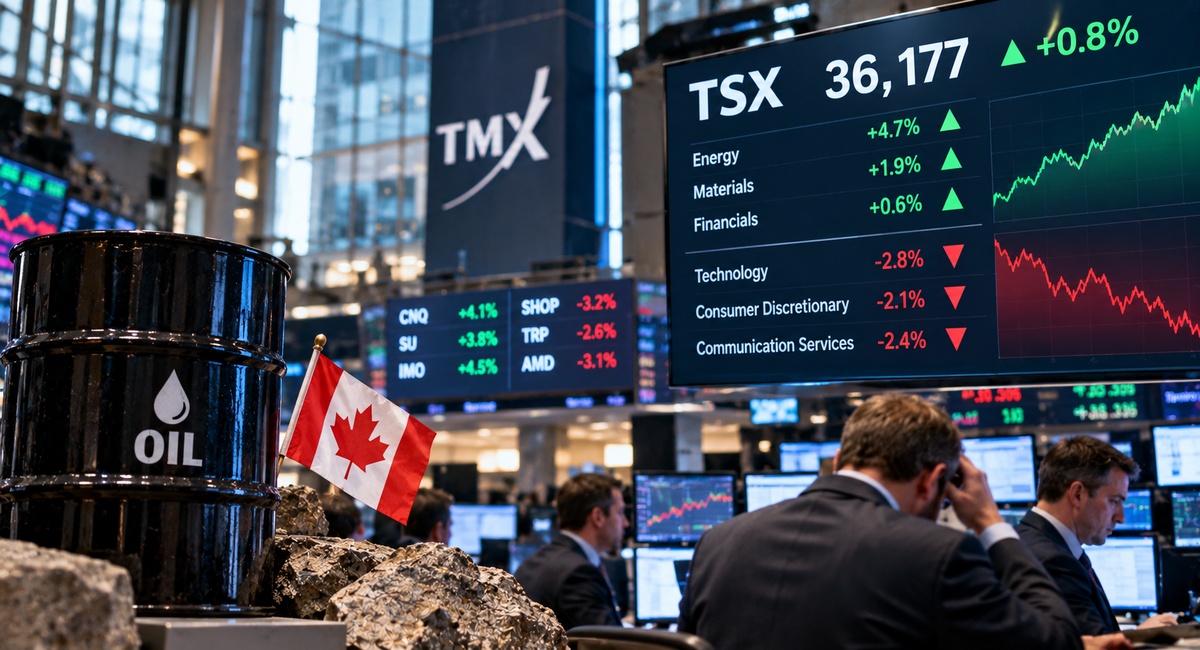
The S&P/TSX Composite closed Friday at 36,176.55, up 1.4% on the week and 2.4% below its August record of 37,069.11. The close came after a reversal: the index reached 36,462.46 intraday, the high of the period, then gave back 286 points as technology stocks sold off into the finish. December futures were down 0.16% at 5:50 a.m. ET Monday, according to MarketScreener.
Energy Against Technology
The spread between the two sectors is the week. The TSX gained 1.4% from the Oct 9 close while the Nasdaq Composite lost 4.5% and the S&P 500 lost 1.9%, its worst week since June, according to the Associated Press. Canadian Natural Resources rose 3.2% on Friday, Imperial Oil 2.9%, Suncor and Cenovus 2.7% each and Enbridge 2.3%, as Brent settled at US$109.86, according to Trading Economics.
Technology absorbed the losses. Shopify fell 5.1%, Celestica 3.9% and Constellation Software 3% on Friday, while the US chip selloff reached an eighth straight losing session, the longest run since 2008. Micron lost 5.6% in New York. Banks were subdued after the Bank of Canada governor spoke, and miners were mixed as gold and silver fell.
The TSX has climbed 3.5% from its Oct 1 low of 34,938.01 and closed 1.5% above its 10-session average of 35,640, with volume averaging 286 million over the last four sessions against 258 million over the prior fifteen.
Daily open, high, low and close for the S&P/TSX Composite, with volume bars coloured by direction and a 10-session simple average computed from the closes. The TSX was closed Oct 12 for Thanksgiving, and Sep 18 is excluded because its 628 million volume distorts the scale.
Rates Are Now Part of the Tape
Governor Tiff Macklem said on Oct 16 that the Bank of Canada has not yet raised rates but that prolonged high energy prices make its job harder, according to Trading Economics. Traders price a 35% chance of a rate increase when the Bank meets on Oct 28 and nearly 70% odds of a quarter-point increase by year end, according to LSEG data cited by MarketScreener. Headline CPI reached 3.1% in September.
The bond market is making the same argument. The US 10-year Treasury yield eased to about 5.08% on Monday from 5.13% on Friday, after touching 5.35% earlier this month, its highest since 2002, according to the Associated Press. Higher yields pressure the indebted and growth-heavy companies that led Friday losses.
Levels and Catalysts
Resistance sits at the Friday high of 36,462.46 and support at the Oct 1 low of 34,938.01, with the 10-session average near 35,640 in between. A close above the high would leave the August record 1.7% away. Brent was near US$108 on Monday after the Russian sanctions waiver, still well above US$100, which keeps energy as the offset to technology.
The base case is a range between the Oct 1 low and the Friday high while oil holds above US$100 and technology stabilizes. The tail risk is that both supports fail together: the chip decline spreads to the large Canadian technology names while a Hormuz de-escalation pulls oil lower. The calendar is crowded, with Meta, Netflix, General Motors, Tesla and IBM reporting this week, Lam Research on Wednesday, and the Federal Reserve and Bank of Canada deciding on Oct 27 and 28.