
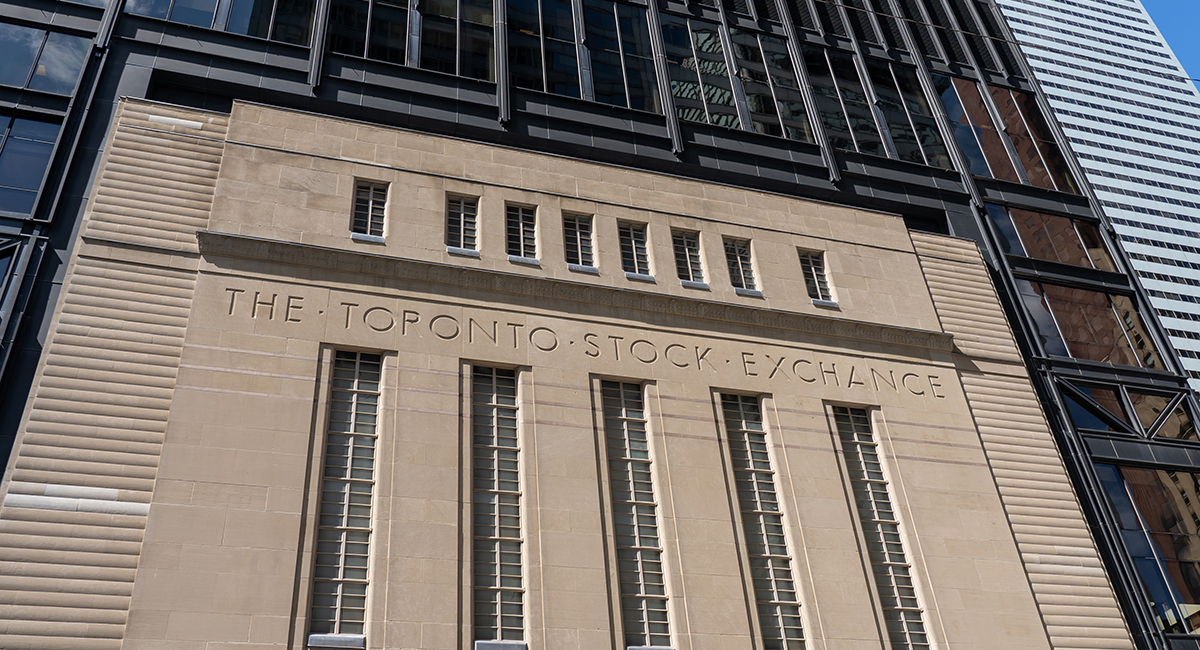
The TSX Composite closed at 34,734 on Monday, down 34 points and fractionally negative on the session. The number tells almost nothing about what actually happened. The TSX Capped Energy Index gained 2.12% as WTI crude closed roughly 6% higher following Iran's announcement that it was suspending talks with Washington and reaffirming the Hormuz closure. The TSX Capped Financial Index fell 1.33% as bank stocks repriced around renewed anxiety about what the Bank of Canada does on June 10. Those two moves, in opposite directions, largely cancelled each other in the composite index and produced a headline that looks like nothing happened.
Something happened. The ceasefire framework that had been driving oil lower through May revealed a structural vulnerability, and the TSX's sector composition responded accordingly.
The Bank Selloff and What It Is Pricing
TD Bank fell 2.8% on Monday, the steepest decline among the major Canadian banks, compounded by BMO's announcement that it had hired senior TD executive Trevor van Arragon. CIBC dropped 2.5%, Scotiabank shed 1.5%, and RBC lost 1.3%. The bank selloff is not primarily a credit story. It is a rate curve story.
Canadian bank earnings are sensitive to the shape of the yield curve because net interest margins depend on the spread between short-term deposit rates and longer-term lending rates. When the market prices a higher probability of a BoC rate hike, the short end of the curve rises faster than the long end, compressing the spread that drives bank profitability. Monday's oil re-acceleration, with Brent finishing near $95 against the BoC's $90 Q2 baseline, moved the probability distribution for June 10 toward a hawkish hold or an outright hike. The banks sold off on that repricing.
BMO's 0.6% gain is the exception that confirms the mechanism. The van Arragon hire is a firm-specific positive catalyst that overrode the sector headwind. Every other major Canadian bank declined on the same day BMO rose. That divergence is not noise. It is the market attributing the BMO move entirely to the idiosyncratic event rather than any sector-level improvement.
Energy Names and the Oil Arithmetic
The chart above shows the TSX Capped Energy Index and TSX Capped Financial Index performance since the conflict began in late February, indexed to 100, alongside WTI crude. The divergence between the two sectors has been the defining feature of the TSX since March and widened further on Monday.
The energy-financials divergence that opened in early March widened further on June 1; the April 8 ceasefire produced a partial convergence that has since reversed as oil re-accelerated and rate anxiety returned ahead of June 10.
CAD and the Ambiguous Oil Signal
The Canadian dollar's failure to rally on a 6% WTI spike is analytically significant. In a normal commodity-currency relationship, a sharp oil move of that magnitude would be expected to produce a meaningful CAD appreciation against the USD. CAD/USD instead fell 0.13% to 0.7219 on Monday.
The explanation is the same one that has governed the CAD trade since March: the market cannot decide whether higher oil is net positive for Canada through the terms-of-trade channel, or net negative through the inflation-and-BoC-hike channel. When oil rises because of a genuine demand expansion, Canada benefits. When oil rises because of a geopolitical supply shock that simultaneously threatens global growth and forces central banks toward tighter policy, the calculus is less clear. Monday's move was unambiguously in the second category. CAD priced it accordingly.
The WTI-CAD correlation has broken down materially since the conflict began. Advisors with clients in U.S.-dollar holdings or global equity mandates should note that the currency hedge decision on CAD exposure is not resolving the way the historical relationship would suggest. The oil price and the Canadian dollar are now telling different stories about the same event, and the CAD's story is the more cautious one.
Gold, Mining, and the Shopify Exception
Agnico Eagle fell 3.6% and Wheaton Precious Metals dropped 3.8% on Monday as gold prices declined. The gold selloff on a day of geopolitical escalation is counterintuitive but reflects a specific dynamic: the partial diplomatic recovery through the session reduced the flight-to-safety bid that had been building in pre-market trading. Gold's intraday pattern mirrored oil's, spiking on the initial Iran announcement and then fading as the Trump-Hezbollah ceasefire news circulated. The net result was a gold decline by end of session, pulling the TSX materials sector lower.
Shopify's 4.4% gain stands apart from the geopolitical narrative entirely. Nvidia's announcement of a new advanced PC processor drove broad technology sector strength on Wall Street, and Shopify tracked that move. The TSX's technology component, while smaller than its U.S. equivalent, is now large enough that a strong Nasdaq session can partially offset sector-level weakness in financials or materials. Monday's composite near-flat outcome is partly a function of that three-way split: energy up, financials down, tech up independently.