
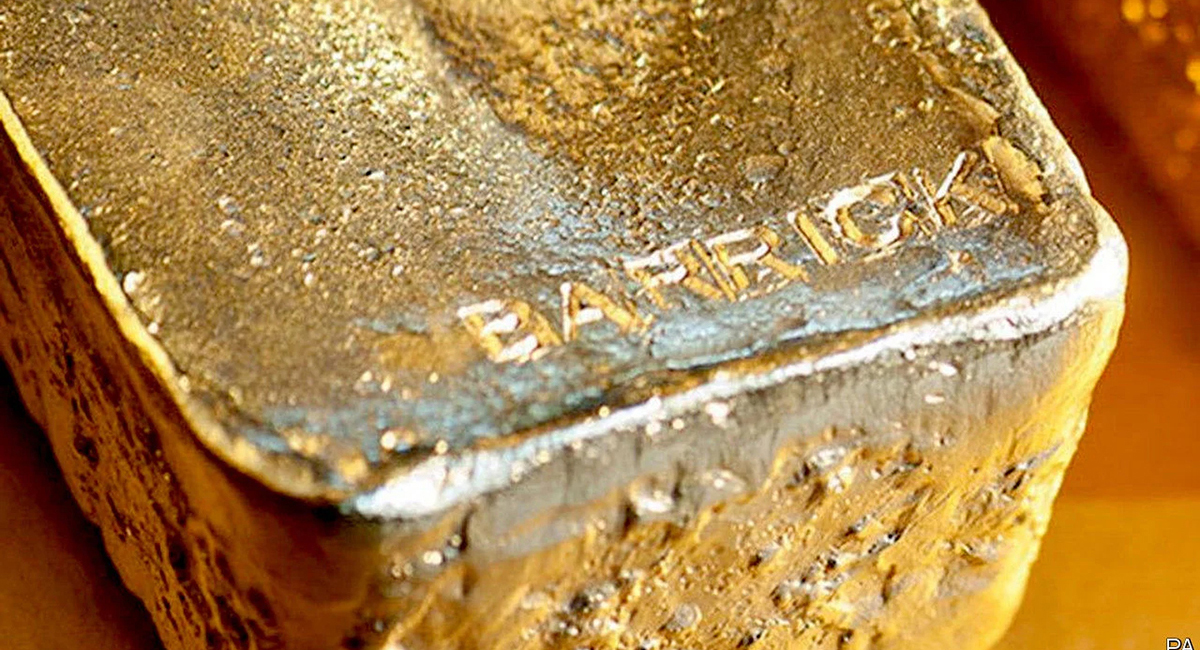
Barrick Mining reported second quarter earnings before Monday's open that beat the company's own production guidance, grew net earnings 50 percent year over year and cleared the last major obstacle to a planned IPO of its North American gold assets. The stock closed the session down 6.45 percent, the single worst performer on the TSX composite.
The gap between the quarter Barrick actually delivered and the reaction investors gave it is the story. Adjusted earnings per share came in at 82 cents against a Street estimate of 84 cents, a miss of two cents. That two cent gap moved a $57 billion company's share price more than every other number in the release combined.
What Actually Happened in the Quarter
Barrick produced 796,000 ounces of gold in the quarter, above the top end of its 730,000 to 770,000 ounce guidance range, helped by a faster than planned ramp up at Loulo-Gounkoto and a quicker recovery at Pueblo Viejo. Revenue rose 44 percent year over year to $5.29 billion. Net earnings rose 50 percent to $1.22 billion, or 73 cents per share, up from 47 cents a year earlier.
The company also repurchased $1.2 billion of stock during the quarter and settled its long running Nevada Gold Mines dispute with Newmont for a $1.95 billion cash payment, a resolution that removes the last structural hurdle to the North American gold assets IPO Barrick still expects to complete by year end. None of that is what moved the stock on Monday.
Barrick's own results, set against Monday's share price reaction, make the point cleanly: nearly every operational and financial metric in the quarter improved, while the one metric that missed a narrow consensus figure dominated the market's response.
Adjusted earnings of 82 cents per share landed narrowly below the Street's 84 cent consensus. Every other line in the release, including production, revenue growth and cash flow, moved in the opposite direction from the share price.
The Overreaction Pattern Thaler's Research Describes
Richard Thaler's work on investor overreaction, building on the original De Bondt and Thaler finding that stocks with recent strong news tend to get bid up beyond what fundamentals justify, describes exactly this setup. Investors anchor heavily on the single most salient, most recently reported figure, in this case the earnings per share miss, and underweight the broader set of results sitting beside it in the same release.
The earnings per share line is the number that appears in the headline and the pre-market alert. Production guidance, cash flow growth and a dispute settlement worth nearly $2 billion require reading past the first paragraph. The availability of the miss, not its actual weight in the company's fundamentals, is what set Monday's price action.
Why the Timing After a 30 Percent Rally Made It Worse
Barrick shares had rallied roughly 30 percent since mid-July heading into the earnings release, according to Benzinga's trading data. A stock that has already run that far accumulates a large pool of investors sitting on substantial paper gains, and a large pool of unrealized gains is precisely the condition under which a modest negative catalyst triggers disproportionate selling.
Investors holding a big unrealized gain look for a reason to lock it in. A two cent earnings miss, arriving after a 30 percent run, gave that reason. The selling that followed was less a verdict on Barrick's quarter than a verdict on how far the stock had already travelled before the quarter was reported.
What the Metal Itself Was Doing
Gold traded near $4,391 an ounce on Monday, essentially flat on the session, its highest opening level since early June following Friday's weak US employment report. The commodity Barrick mines was not repricing lower. The stock's move was specific to how the market processed Barrick's own results, not a read on gold's outlook heading into this week's US inflation data.