
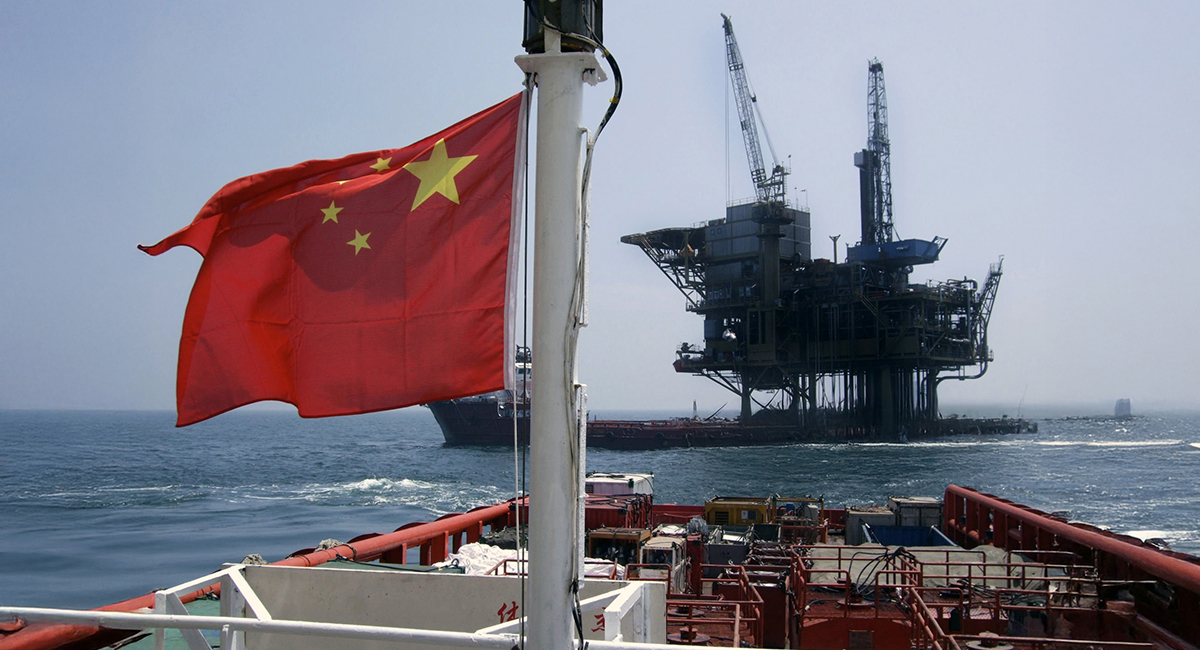
Asian refiners, and China in particular, are buying more Canadian crude than at any point since the Trans Mountain expansion was completed. China alone is now taking in more than 200,000 barrels a day, making it Canada's single largest crude customer. The mechanism is direct: Asia is the largest client of both Gulf producers and Canada, and the war in the Middle East has forced a portion of that demand to shift toward the more reliable, non-Hormuz source.
The Chain: From Hormuz to a Full Pipeline
The Strait of Hormuz remains the contested chokepoint. Iran continues what shipping monitors describe as almost daily attacks on vessels, and war-risk insurance premiums for the route have surged repeatedly since July. Every disruption there raises the value of a barrel that does not have to pass through it. Canadian crude, delivered by pipeline to the Pacific coast rather than by tanker through a contested strait, is exactly that barrel.
Trans Mountain's 890,000 barrel a day capacity is already being outpaced by the demand the Hormuz disruption is generating, with China's own purchases alone approaching a quarter of total throughput.
Trans Mountain's 890,000 barrel a day pipeline reached full capacity for the first time since its expansion, with China alone accounting for more than 200,000 of those barrels. A 2029 target of 1.2 million barrels a day remains the earliest scheduled relief for the current bottleneck.
Trans Mountain has reached full capacity for the first time since its expansion, and the pipeline operator has said this month it is seeing more demand than it has room to move. A further 90,000 barrels a day of capacity is potentially available through drag-reducing agents, and a separate expansion project could add another 72,000. Full capacity of 1.2 million barrels a day is not targeted until 2029. Until then, the diversification trade has a hard ceiling.
Who Actually Captures the Re-rating
The infrastructure constraint does not mean the trade has no equity expression today. Veritas Investment Research analyst Darryl McCoubrey raised valuations on Cenovus Energy and Canadian Natural Resources by close to 30% in March, upgrading Cenovus to a strong buy. His reasoning was specific: unlike integrated majors with downstream refining operations that smooth out crude price swings through crack spread margins, Cenovus and Canadian Natural Resources have outsized exposure to the raw WTI price. When crude spikes on a supply shock, they capture more of the move than a refiner-hedged producer such as Suncor.
That thesis has continued to play out. Brent crude has climbed from roughly $90 a barrel in March to $94.11 by September 1, then added more than 4% intraday on September 2 after a second wave of U.S. strikes on Iranian military infrastructure killed at least 11 people and drew Iranian retaliation against Jordan, Bahrain, Iraq and Kuwait within hours. On the TSX Tuesday, Athabasca Oil, Parex Resources, Canadian Natural Resources and Tamarack Valley Energy each climbed more than 3.5% while broader market sentiment turned negative on the same news.
The Base Case, Not the Tail Risk
This is not a scenario where Canadian energy benefits only if the conflict escalates further. The re-rating mechanism McCoubrey identified in March, and the demand diversification now visible in Trans Mountain's own throughput data, are both already realized rather than speculative. The tail risk sits elsewhere: a ceasefire or a rapid de-escalation would remove the war premium from Brent quickly, and with it, a meaningful share of the valuation gap that has opened between Cenovus and Canadian Natural Resources on one side and the integrated majors on the other.