
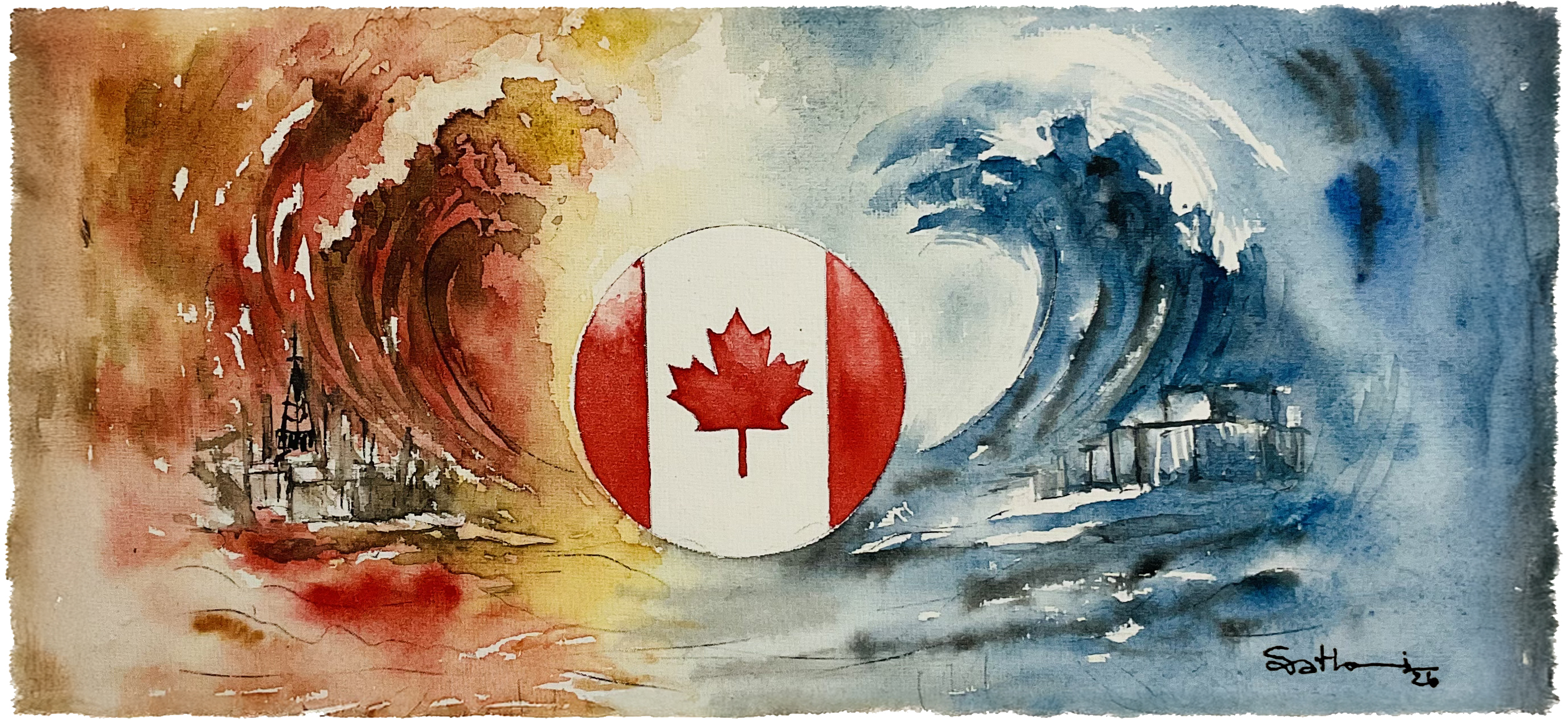
Crude oil closed the week just above 100 US dollars a barrel, roughly 25 per cent higher than where it traded in mid-August, the product of a tanker war between the United States and Iran that has now run for more than six months in the Strait of Hormuz. Five days of HDQ coverage treated that single fact from five different angles: a rate decision, a currency puzzle, a psychology warning, a tax planning window, and a market that refused to follow the sector everyone expected it to lift. Held together, the five angles describe something none of them showed on its own. The same barrel of oil is now pulling the Bank of Canada and the Federal Reserve toward opposite policy paths, and it is pulling the TSX away from its own energy sector rather than with it.
Two Central Banks Reading the Same Barrel Differently
The Bank of Canada held its overnight rate at 2.25 per cent on September 2, the seventh consecutive hold of this cycle. A statement from Governor Tiff Macklem named gasoline-driven inflation as a risk rather than an emergency, warning that "the longer that high oil prices and elevated refinery margins persist, the greater the risk of spillover to the prices of other goods and services." Headline inflation was already running near 3 per cent. Core inflation measures tracked separately by the Bank remained closer to target.
Two days later, a jobs report showing Canada lost 42,000 positions in August, with wage growth slowing to its weakest pace since 2017, gave the Bank a second, conflicting signal. Wage growth at a nine-year low argues for a lower rate. Headline inflation at 3 per cent, driven by the same tanker war pushing gasoline prices higher, argues against it. The HDQ Economy Desk called it the hardest read of the cycle, and the September 2 hold reflects a bank choosing patience over commitment to a rate path.
The Federal Reserve is reading the same barrel and arriving somewhere close to the opposite conclusion. A blowout August jobs report pushed futures markets to price 60 per cent odds of a Federal Reserve hike within days, then to roughly 70 per cent by the end of the week, ahead of the September 16 decision. Twelve months ago the two central banks were cutting in near lockstep. This week, an oil shock that both central banks are watching through their own domestic inflation channels is pulling one toward a hold and the other toward a hike.
WTI has risen in nine of its last ten trading sessions, with its sharpest single-day move landing the day after Houthi forces aligned with Iran struck three Saudi Aramco facilities on September 9.
The climb in WTI from 82.17 US dollars on August 12 to 100.05 US dollars on September 11 tracks the escalation from a Hormuz chokepoint dispute to direct strikes on Saudi supply infrastructure. Source: Investing.com daily settlement data.
Why the TSX Fell While the Sector Oil Was Supposed to Lift Kept Rising
On Tuesday, WTI climbing toward 94 US dollars put Canadian energy names on what HDQ Market Desk coverage called the right side of two stories at once: a rising oil price and a softer set of US equity futures. That relationship did not hold for the rest of the week.
By Thursday the TSX composite had fallen in four of its previous five sessions, closing at 35,906.56, down 0.6 per cent, even as the same oil rally continued. Friday extended the pattern. The composite closed at 35,616.77, down 0.81 per cent and a six-week low, as a US procurement threat aimed at Canadian engineering and infrastructure names outweighed a barrel of oil trading above 100 US dollars. Week over week, the index is down about 2.5 per cent from the previous week close of 36,513.80.
The lesson is not that oil stopped mattering to Canadian equities. It is that a second, unrelated shock, a trade and procurement dispute layered on top of the tanker war, is now large enough to override the correlation between crude prices and the TSX that has held for most of this six-month conflict. An advisor fielding a client question about why energy stocks are up while the overall portfolio is down needs the tariff story, not the oil story, to answer it accurately.
The Currency and the Fear Gauge Are Both Underreacting
Three separate HDQ articles this week, published on three separate days, made the same observation about the Canadian dollar without initially connecting it to each other. It is not moving the way a 25 per cent oil rally should move it. Geopolitical coverage on September 8 traced the mechanism from a Hormuz tanker attack to Canadian currency markets. Market Desk coverage on September 9 noted that Government of Canada bond yields moved with a Wall Street selloff while the currency strengthened anyway. Geopolitical coverage on September 10 named the muted response directly as the signal worth watching, not the oil price itself.
The Behavioural Desk spent the same week describing a parallel mismatch in investor psychology. An AAII sentiment survey on September 9 showed both bullish and bearish readings running above their historical averages simultaneously. On September 10, the desk warned that recency bias was pulling clients into the energy rally at a weak entry point, citing research from Barber and Odean on the cost of chasing recent performance. By September 11, a four-week climb in the VIX had arrived without the investor anxiety that normally accompanies rising volatility, a pattern the desk called a warning sign rather than reassurance.
Read separately, a quiet currency and a quiet VIX both sound like calm. Read together, against a week that just forced the Bank of Canada and the Federal Reserve into their widest policy split in a year, they describe a market that has not yet priced the size of what is happening underneath it. That gap, not the level of any single number, is what carries into the Federal Reserve September 16 decision and the Bank of Canada next meeting in October.