
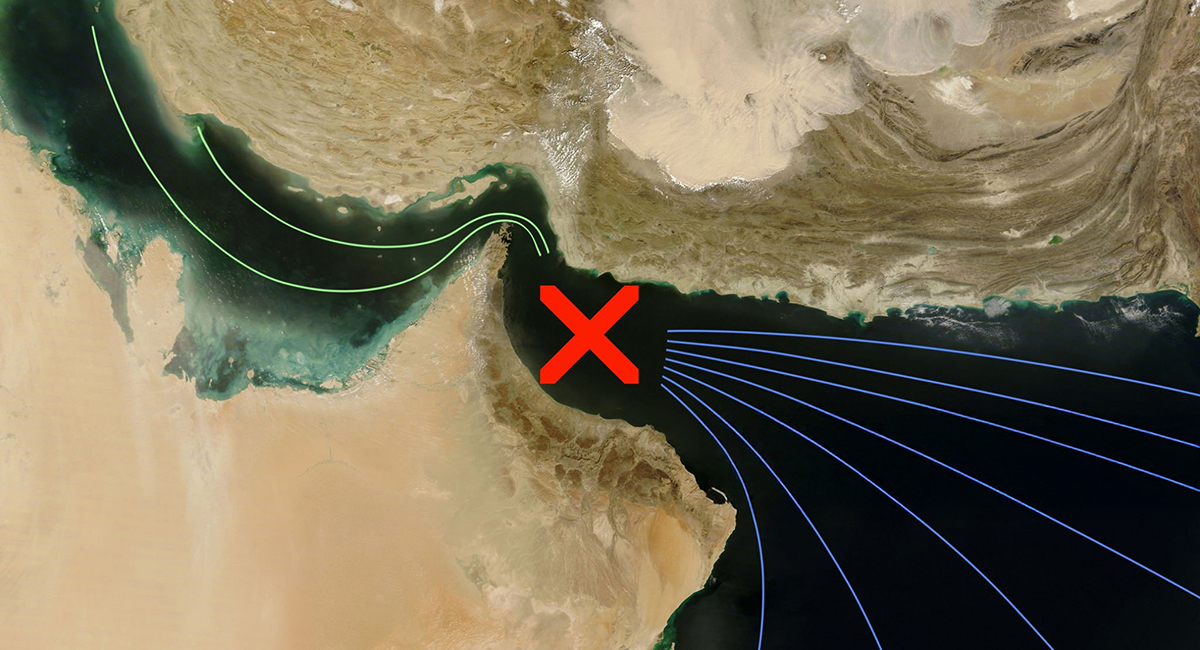
Crude oil fell for a fourth consecutive session Monday, with WTI dropping to $94.01, down from a September 10 peak of $102.48. The proximate cause is diplomatic rather than physical: reports over the weekend that President Trump is open to meeting Iranian President Masoud Pezeshkian at the UN General Assembly in New York this week, after the United States granted visas allowing top Iranian officials to attend. Increased Saudi shipments have also eased near-term supply concerns.
None of this has actually reopened the Strait of Hormuz. Vessel traffic through the strait has averaged just 13 ships a day over the past ten trading days, against a pre-war flow of roughly 20 million barrels daily. The tanker war that produced that collapse has not stopped. What has changed is that the market is now pricing a real chance it could be negotiated down this week, rather than escalated further.
The Chain From Tehran to the TSX
The mechanism connecting this to Canadian portfolios runs in a straight line. Iran effectively closed the Strait of Hormuz in retaliation for earlier U.S. and Israeli strikes, and the tanker exchanges that followed, U.S. strikes on three Iranian oil tankers and Iranian missile strikes on two U.S. warships in a single 24-hour period earlier this month, pushed WTI from the low $90s toward $102 by September 10. The TSX energy sub-index was the lone gainer among Canadian sectors through that stretch, up 0.71 percent on the week even as the broader composite slipped. The Canadian dollar, meanwhile, moved the other way: a falling oil price on top of a widening Bank of Canada-Federal Reserve rate gap has pushed USD/CAD back above 1.40.
Gold tells the same story from a different angle. The metal closed at a record $4,424.90 an ounce Friday, up $25.20 on the day, as investors bought safe-haven protection against a conflict that was still actively producing tanker strikes and missile exchanges as recently as two weeks ago. Gold has not yet priced the same de-escalation that oil started pricing this weekend. That gap between the two markets is itself informative: it suggests the diplomatic opening is being read by oil traders as a real, near-term possibility, while gold holders are treating the underlying conflict as unresolved regardless of how the New York meetings turn out.
The September 10 peak followed U.S. strikes on three Iranian oil tankers and Iranian missile strikes on two U.S. warships. The decline since September 15 tracks reports of a possible Trump-Pezeshkian meeting at the UN General Assembly.
Tail Risk, Not Base Case, in Either Direction
The honest read this week is that neither outcome is the settled expectation. A genuine diplomatic opening at the UN General Assembly is plausible: the United States has granted visas to senior Iranian officials specifically to attend, and Trump has publicly signalled openness to a direct meeting. But Trump has paired that openness with an explicit warning about consequences if no agreement is reached, and the underlying military exchange, tankers struck, warships targeted, has not paused during the diplomatic overture. Both a real de-escalation and a return to the September 10 trajectory remain live possibilities through the end of this week.
For Canadian portfolios, the practical takeaway is that the oil price move this week reflects a probability shift, not a resolution. Energy sector exposure, the Canadian dollar, and gold are all still trading on a conflict that has not concluded, and the range of plausible outcomes by Friday remains wide in both directions.