
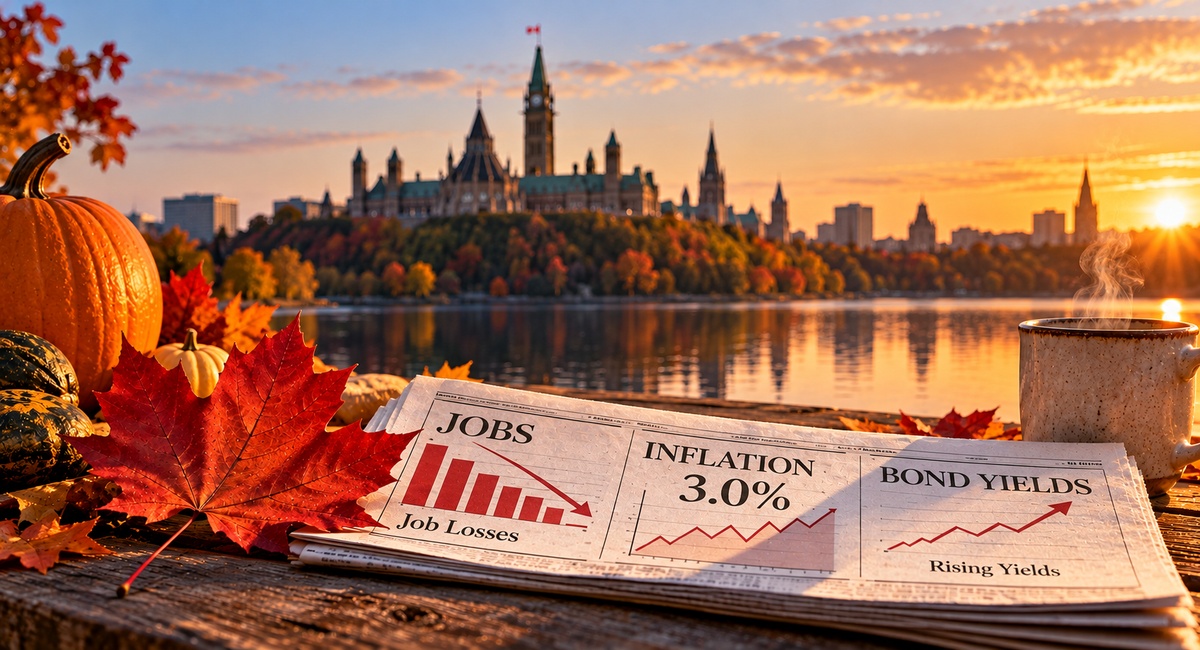
Canada lost 68,300 jobs in September, and the unemployment rate rose to 6.5% from 6.4%, Statistics Canada reported Friday. The decline follows a 41,700 loss in August, and the rate stayed near its two-year low largely because the labour force kept shrinking. The Bank of Canada makes its next decision on October 28, 16 days from now, with the policy rate at 2.25%.
Inflation is pulling the other way. Headline CPI held at 3.0% in August, with gasoline doing most of the work: excluding gasoline, prices rose 2.4%, and the Bank of Canada core gauges, CPI-trim at 1.9% and CPI-median at 2.0%, sit at or just below the 2% target.
A 10-cent-per-litre federal gasoline tax holiday, extended through year-end, is already holding down pump prices. InvestingLive noted that gasoline has still risen materially in September, which makes the September CPI release on October 19 the last major data point before the decision.
Why October 28 Is Harder Than the Headline Numbers Suggest
The Bank of Canada held at 2.25% on September 2 and said upside risks to inflation had increased, adding that it was prepared to adjust policy as needed, according to the Canadian Real Estate Association summary of the decision. That language put a rate increase back on the table. A contracting labour market complicates any move to deliver one.
Trade policy is the swing factor. The United States imposed 50% tariffs on C$27.6 billion of Canadian goods on August 22, roughly 5% of exports, and Canada answered with matching counter-tariffs on September 8 after negotiations collapsed, according to Reuters and the Government of Canada.
ATB Economics estimates the combined measures will reduce Canadian GDP growth by roughly half a percentage point, with the largest effect in 2027, and expects the Bank to hold through 2026. The central bank therefore faces a shrinking workforce, core inflation near target and a tariff shock that raises prices while it slows growth. The October 28 announcement arrives with an updated Monetary Policy Report.
The Bond Market Is Setting Mortgage Costs Before the Bank Does
The Government of Canada five-year yield has climbed to about 3.7%, more than three times the sub-1% levels that prevailed when millions of Canadians took out five-year fixed mortgages in 2020 and 2021, according to Canadian Mortgage Professional magazine. The 10-year yield rose to 3.99% from 3.45% at the start of July, and the two-year moved from 2.76% to 3.37% over the same period, according to Morningstar.
That repricing reaches households without any Bank of Canada move. The lowest insured five-year fixed mortgage rate was 4.34% on October 7, according to Ratehub.ca, and Equifax Canada reported that mortgage delinquency balances rose 32% year over year nationally in the first quarter of 2026, and 52% in Ontario.
The S&P/TSX Composite has fallen 3.5% from its August 25 close of 36,957.63 over a period in which tariffs, a firmer central bank tone and higher yields arrived in sequence, then rebounded 1.48% on Friday to close at 35,664.62.
The decline from the August 25 close spans the U.S. Section 338 tariffs of August 22 and the Canadian counter-tariffs of September 8. Friday gained 519.24 points, or 1.48%, after the September labour force survey.
Crude traded near US$91.67 a barrel and gold near US$4,208 an ounce in late-morning trading Friday, according to The Canadian Press, with the Canadian dollar near 70 cents U.S. The Toronto Stock Exchange is closed today for Thanksgiving and reopens Tuesday, October 13, according to TMX Group.
A Short History of Canadian Thanksgiving
Canadian Thanksgiving is older than most of the institutions that now observe it. In 1578, the English explorer Martin Frobisher and his crew held a ceremony of thanks in the eastern Arctic after a difficult voyage, which the Canadian Encyclopedia credits as the first of its kind held by Europeans in North America. In the early 1600s, Samuel de Champlain founded the Order of Good Cheer at Port Royal, a series of rotating feasts shared with Mi’kmaq neighbours that helped settlers through the winter.
The date moved for centuries. Parliament declared November 6, 1879 a national day of thanks, and the holiday later shared a date with Armistice Day until Remembrance Day was set apart in 1931. On January 31, 1957, Parliament fixed the observance on the second Monday in October, tied to the harvest that the holiday was created to mark.
What the Day Means for Financial Advisors
This Thanksgiving falls between a labour report showing 68,300 lost jobs and a rate decision 16 days away, a calendar that tests client relationships more than portfolios. Across Canada, advisors will spend part of the weekend with the families whose finances they know in detail: the couple renewing a mortgage signed in 2021, the retiree watching a withdrawal schedule, the business owner pricing tariff costs into next year.
Trust in the profession is built in unremarkable moments: a call returned during a 3.5% drawdown, a renewal discussed six months early, a plan that stated in advance what a pullback of this size would mean.
Gratitude, in that setting, is practical. It is the recognition that a family has handed over decisions about its security, and that the handover carries an obligation the markets do not pause for, even on a holiday Monday.
A Note of Thanks
To the advisors and readers of HDQ across Canada: thank you for the attention you give this publication each morning, and for the work done for the families who rely on you. We hope the long weekend leaves room for a proper meal and an unhurried conversation. Happy Thanksgiving from everyone at HDQ Editorial.
Markets reopen Tuesday, and HDQ publishes in full that morning.