
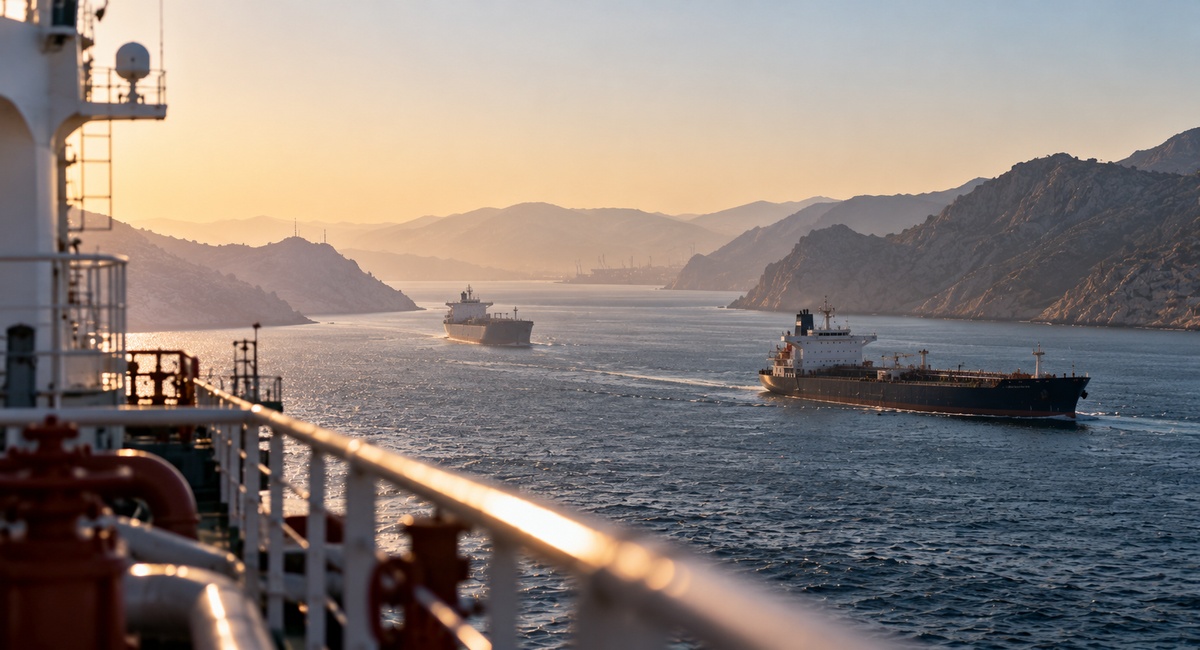
Brent crude settled at $115.32 on October 28, up 1.3%, and West Texas Intermediate settled at $102.78, up 2.9%, as the Strait of Hormuz entered its 242nd day of closure. Prices slipped about 1% in Asian trading on October 29 after reports that Vice President Vance had written to Iranian official Mohsen Rezaei to revive talks.
The spot assessment of Brent has stayed far above where September began, rising from 96.02 dollars on September 1 to 123.10 on October 27 and jumping by more than 20 dollars in a single session on October 2.
The spot assessment ran above the front-month futures contract, which settled at $115.32 on October 28. Days without an EIA reading do not appear.
A Closure Measured in Transits
The IMF PortWatch tracker recorded two transits through the strait on October 25, against a baseline of about 85 a day before the conflict. It counted four on October 18. War-risk insurance for the passage costs about 32 times its pre-crisis level.
Pre-war Brent traded near $72. An April ceasefire took the price to $92.77, but it collapsed, and the market has not returned to that level since. The U.S. Energy Information Administration reported on October 28 that crude inventories fell by 1.9 million barrels, the fourth straight weekly draw, while gasoline stocks rose 3.9 million.
Diplomacy and Its Limits
The Vance letter is the only concrete sign of movement, and the other signals point the opposite way. Iran dismissed a Qatari draft as unacceptable ideas, and President Trump denies that talks are under way. The Iranian seven-day plan to reopen the strait and its seven conditions date from a June memorandum agreed in Islamabad.
The security picture is deteriorating at the edges. Houthi forces claim attacks on a Saudi refinery and on Aden airport, Iran says it has shot down its fourteenth American MQ-1 drone, and a tanker was reported on fire in the strait on October 29. Unconfirmed reports say Washington has told Gulf states to prepare for strikes after the November 3 midterm elections.
What Prices and Forecasters Imply
Betting markets are skeptical of a quick fix. Polymarket puts the odds of normal Hormuz traffic by December 31 at 12%, and at under 1% by October 31. UBS sees Brent near $110 at year end, and the EIA October outlook, published October 6, projects fourth-quarter Brent near $105 and a 2026 average of $96.32.
A Reuters poll puts the 2026 average at $89.05, a figure that includes the pre-war months and so sits below the current price. The spread between forecasts and the $115 futures price shows how much of the outcome depends on a reopening that traffic data does not yet show.
The Canadian Transmission
Oil at this level feeds Canadian inflation directly. Statistics Canada reported that energy prices were up 19.0% from a year earlier in September and gasoline up 27.8%, and the Bank of Canada cited that pressure when it raised its policy rate to 2.50% on October 28. The Canadian dollar firmed to about 71 US cents after the decision.
The strait remains the variable that moves everything else: energy prices, inflation forecasts and central bank decisions on both sides of the border. Traffic counts, not headlines, are the reading to follow.