
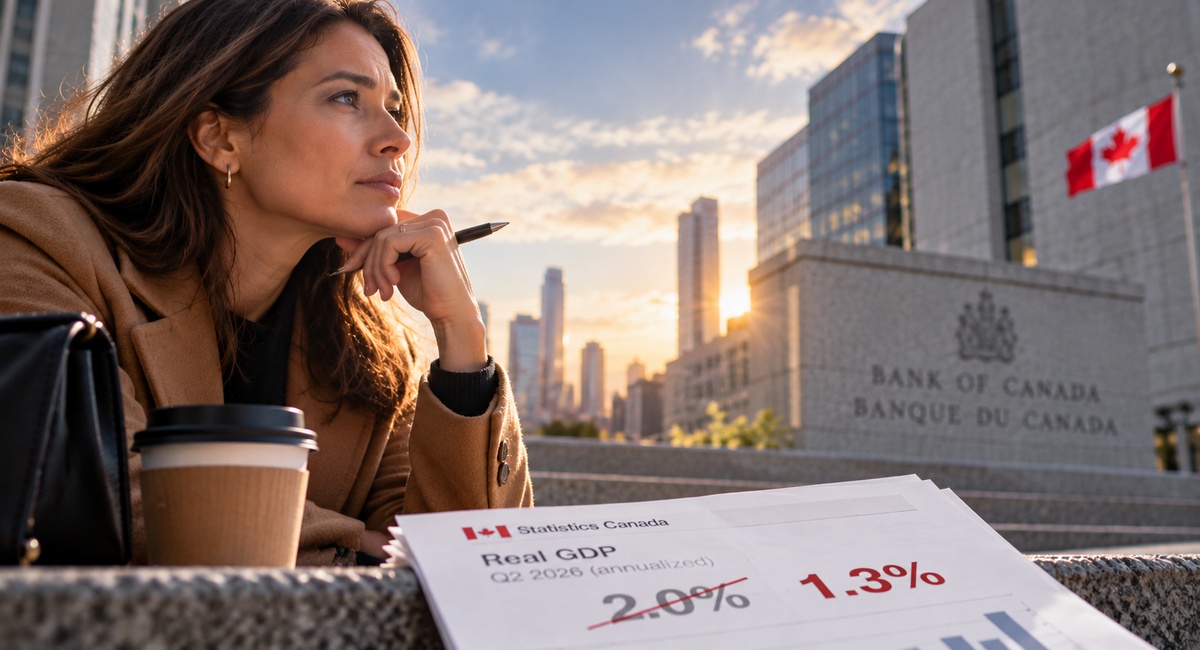
The Bank of Canada raised its overnight rate to 2.50% on Wednesday and lifted its third-quarter growth forecast to 2.0% annualized. Two days later, the flash estimate from Statistics Canada put the quarter at 1.3%, down from 3.3% in the second quarter.
The data landed on a day when oil rose to $104, the TSX fell 1.74% and the Treasury market rallied while gold fell. Each of those moves feeds the same December 9 decision, and they do not point the same way.
The Growth Forecast Behind the Hike Has Moved
August real GDP was essentially unchanged after a flat July, and the advance estimate for September shows a 0.1% decline, led by manufacturing, mining and oil and gas extraction. RBC Economics has the quarter tracking below its own 1.8% base case.
Monthly output has gone from a 0.6% gain in April to three straight months at or below zero, the run that the October 28 forecast now has to be reconciled with.
September is the advance estimate from Statistics Canada. The 2.0% third-quarter forecast comes from the Bank of Canada October Monetary Policy Report.
Labour data points the same way, with employment down 68,000 in September and the unemployment rate up to 6.5%. On Wednesday, markets priced a 45% chance of another hike on December 9 and a second hike fully by January, and that pricing predates this data.
Oil Pays Producers in Price, Not in Volume
WTI rose 2.2% to $104.23 and Brent 2.2% to $117.36 on concern about renewed U.S. military action against Iran. The Bank of Canada has pointed to energy costs as the reason further increases may be needed, and the producers selling at those prices saw their shares rise.
Volume tells a different story. Oil and gas extraction fell 1.2% in August, its third straight monthly decline, with oil sands output down 2.1% on maintenance in northern Alberta. Equity markets are paying for the price while GDP records the volume.
The S&P/TSX Composite closed at 35,620.03, its lowest close since October 14, after finishing the hike day at 36,265.09.
The shaded window runs from the October 28 rate decision to the October 30 close. The dashed line is a five-session simple average of the closes shown.
Sector weights decided the day more than the benchmark did. TD fell 2.30%, BMO 2.19% and Scotiabank 1.79%, all by more than the index, while RBC fell 1.49%, Suncor rose 2.26% and Imperial Oil rose 5.37%. Cameco lost 7.74%.
The Safety Bid Went to Treasuries, Not Gold
The S&P 500 fell 1.8% to 7,579.97, its worst day since June, and the Nasdaq Composite fell 2.9% to 25,437.00. Intel dropped about 29% on a weak profit outlook and Amazon results raised fresh questions about AI spending, a theme Alphabet opened on Thursday with a 12.64% decline, quarterly capital spending above $51 billion and negative free cash flow.
The 10-year Treasury yield fell 7 basis points to about 4.92% and the VIX rose about 24% to 21.41. Gold fell about 3.6% to roughly $3,887, extending a decline of more than 4% in October, so bullion offered no offset to the equity drop on a day when yields fell.
With U.S. headline PCE inflation at 3.6% and core at 3.1%, falling yields read as growth fear rather than inflation relief. That puts a flat economy, a 6.5% unemployment rate and $104 oil in front of the December 9 decision, and the first read on Monday is whether the 45% hike probability set on Wednesday moves.