
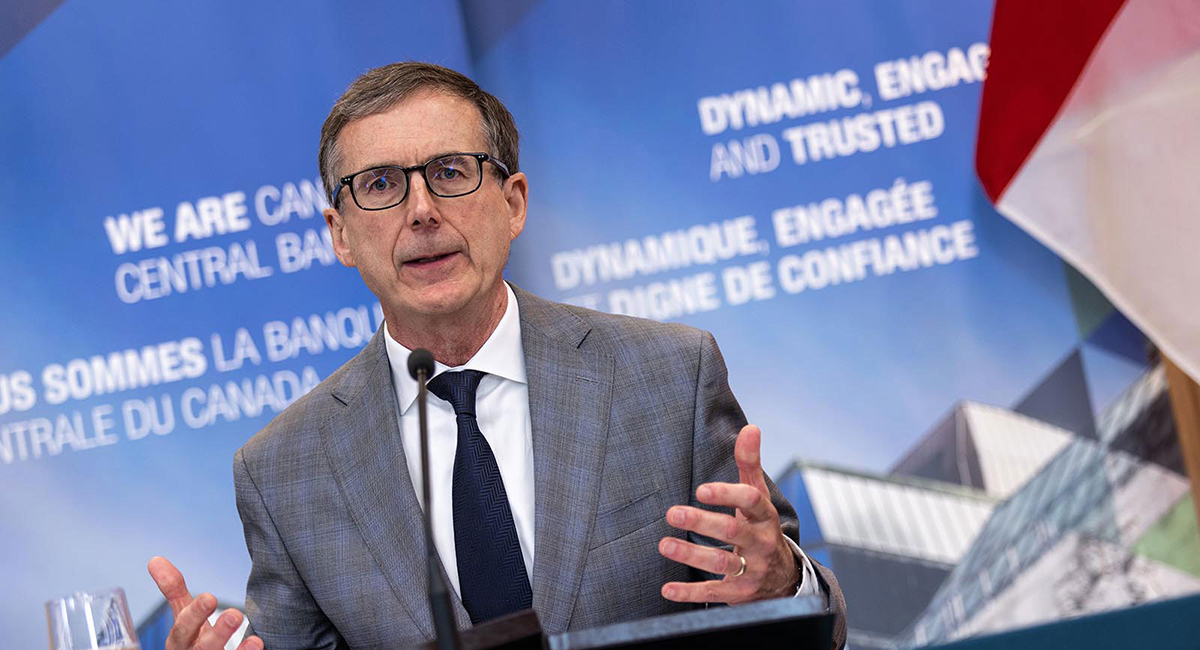
The Bank of Canada's fifth consecutive hold at 2.25% on June 10 confirmed the path the market had long since priced. What distinguished yesterday from the previous four holds was the press conference. Governor Tiff Macklem, flanked by Senior Deputy Governor Carolyn Rogers, offered the clearest articulation of the Bank's policy bind since the current Middle East conflict began in late February.
The core problem is structural. The two dominant forces shaping the Canadian economy are pulling monetary policy in opposite directions simultaneously. Higher energy prices, driven by the Hormuz closure and the resumed US strikes on Iran this week, are pushing headline inflation up and threatening to feed into broader prices. Tariff uncertainty and the resulting drag on business investment and exports are pushing growth down and creating slack in the labour market. One scenario calls for hikes. The other calls for cuts. The Bank is holding because it cannot yet determine which scenario is dominant.
Macklem named this explicitly: "Raising rates to dampen inflation could further slow the economy. Easing rates to support growth increases the risk that higher inflation becomes persistent. For now, holding the policy rate unchanged balances those risks." That sentence is notable because it acknowledges paralysis rather than disguising it as optionality. The Bank is not waiting for the right moment to move. It is waiting for the data to resolve the ambiguity about which direction to move.
What the Core Inflation Data Actually Shows
Canadian headline CPI reached 2.8% year-over-year in April, up from 2.4% in March. The acceleration was almost entirely energy-driven: gasoline prices rose 29% year-over-year in April, reflecting the conflict-related disruption in global oil supply. Excluding gasoline, the CPI rose only 2.0% year-over-year, down from 2.2% in March. The non-energy economy is not generating inflation at a pace that would concern the Bank under normal circumstances.
The BoC's preferred core measures told a more nuanced story. The trimmed-mean rate, which excludes the most extreme price movements in both directions to isolate underlying inflation, cooled to approximately 2.3% in April, its lowest reading in four years. TD Economics described the core softness as "more than expected" and noted there was "little argument yet for Bank of Canada rate hikes" based on the core data alone. RBC senior economist Claire Fan observed that Macklem used "neutral, factual language" when describing downside data surprises, and kept the characterization of economic slack roughly unchanged from April.
The divergence between headline and core inflation is the central diagnostic for the Bank's decision-making through the rest of 2026. If the gap persists, it means energy is doing all the work and the Bank can continue to look through it, as Macklem reiterated it intends to do. If core begins to rise, it means the energy shock is transmitting into the broader price level and the "consecutive increases" scenario becomes the base case rather than a tail risk.
The widening gap between headline CPI at 2.8% and the trimmed-mean core measure at 2.3% reflects an energy-driven inflation episode rather than a broad-based price acceleration; the Bank of Canada is treating the divergence as evidence it can hold without hiking, but Governor Macklem acknowledged the calculus changes if core begins to follow headline higher.
The July 15 MPR Is the Decision That Actually Matters
The Bank's next Monetary Policy Report is scheduled for July 15, alongside the next rate announcement. That is the meeting that matters more than June 10, for a specific reason: July 15 will be the first MPR published after the June 9-10 resumption of US strikes on Iran and the re-escalation of the Hormuz conflict. The April MPR was written before the ceasefire unraveled. The July MPR will incorporate updated oil price assumptions, updated inflation projections, and a reassessment of whether the energy shock is transmitting into core prices in the May data.
The May CPI release, which will land on June 22, is the critical data point between now and July 15. If May's trimmed-mean core holds near 2.3% despite another month of elevated gasoline prices, the Bank's "look-through" logic remains defensible and the hold extends. If core moves above 2.5%, Macklem's language about consecutive hikes becomes less hypothetical.
Scotiabank economist Derek Holt described the June 10 statement as a "placeholder" with four more rate decisions remaining in 2026. BMO Capital Markets expects the overnight rate to remain at 2.25% through 2026, with cuts not before 2027. RBC's Claire Fan kept her assessment of the Bank's position steady and noted that Macklem appears more concerned about the inflationary impact of oil than about reduced household purchasing power. All three views are consistent with a hold through the summer, contingent on the May core data not breaking higher on June 22.
What the Weak Growth Picture Means for the Other Side of the Dilemma
The June 10 statement repeated language from April describing Canadian economic activity as "weak." The BoC noted that higher energy prices and supply chain disruptions are weighing on global growth and that US tariff uncertainty remains elevated. These are not conditions in which a central bank normally hikes rates. They are conditions in which a central bank would normally be cutting. The fact that the Bank is not cutting reflects the inflation constraint imposed by the energy shock.
For Canadian portfolios, the practical implication of this dilemma is a yield curve that refuses to move cleanly in either direction. Government of Canada five-year bond yields, which drive fixed mortgage rates, have remained elevated by the inflation risk premium even as the economic growth picture deteriorates. That compression between a weak growth environment and elevated bond yields is the defining fixed-income characteristic of the current cycle, and it is not resolved by yesterday's hold.