
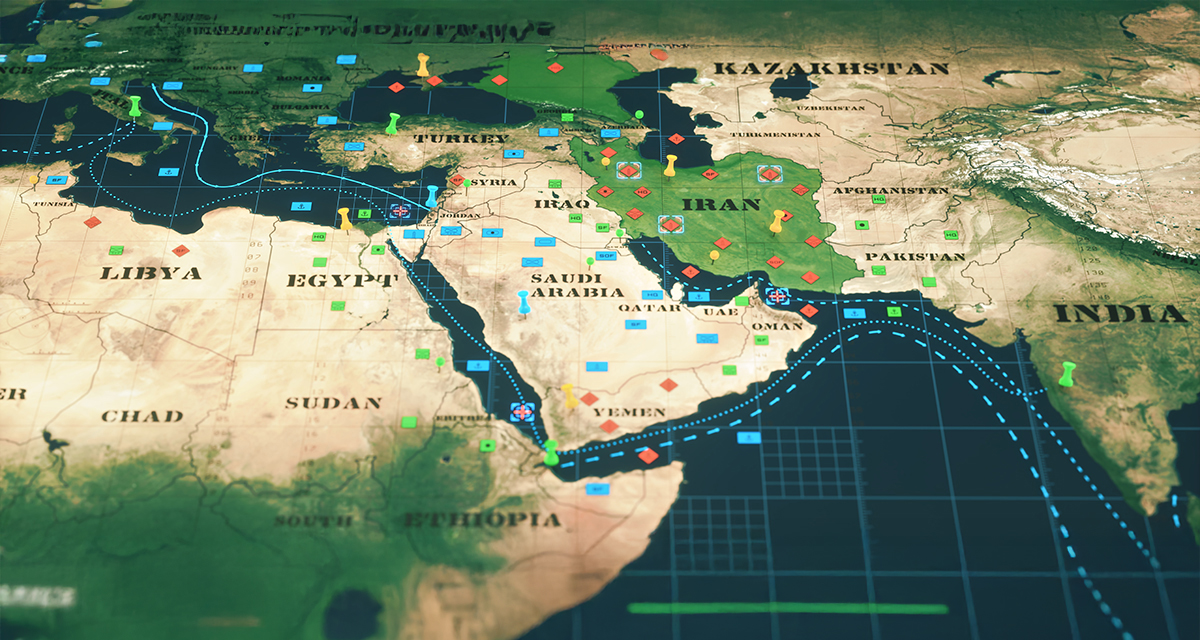
The April 8 ceasefire that briefly sent oil prices down 16% and equity markets higher has now functionally ended. US military strikes on Iran on June 9 and 10, described by US Central Command as "self-defense" responses to the downing of an American Apache helicopter over the Strait of Hormuz, resumed the kinetic phase of the conflict that the ceasefire had paused. Iran retaliated by targeting US military facilities in Bahrain, Jordan, and Kuwait with missile and drone strikes. The exchange marks the first sustained US-Iran military engagement since the ceasefire announcement and represents the most significant escalation since the May 7 strikes.
For global energy markets, the significance of the June 9-10 exchange is not the immediate supply impact. The latest US strikes did not hit Iranian energy infrastructure, and US Central Command denied Iranian claims that the Strait had been fully closed or that a US warship had been struck. Limited tanker volumes continue to move through the strait under third-party coordination arrangements. The significance is what the renewed exchange reveals about the durability of any future agreement: the April ceasefire lasted roughly eight weeks before collapsing under accumulated grievances about Hormuz access, IAEA inspection demands, and the pace of nuclear negotiations. A second ceasefire, if it arrives, will face the same structural tensions.
What the Market Is Currently Pricing and Why It May Be Wrong
WTI crude traded near $88 to $89 per barrel on June 10, a level that reflects a specific implicit assumption: the conflict continues at moderate intensity, with the Hormuz strait partially disrupted but not fully closed, and with no resolution imminent. That pricing is coherent as a base case. It is less coherent as a terminal assumption.
The market's current position sits between two scenarios it has not fully priced. The first is a durable resolution, meaning a new ceasefire that credibly reopens the Hormuz strait and holds. J.P. Morgan has projected full-year WTI averages near $60 if flows normalize. That scenario would produce a 30% decline from current prices and a significant rerating of TSX energy names. The second is a sustained escalation targeting energy infrastructure, which the EIA projected under continued disruption assumptions could push Brent toward $105 in June and July. US crude inventories have already fallen more than 70 million barrels over five weeks, the steepest draw since the 1980s, according to EIA data. Physical tightness is real. A strike on Iranian or Gulf energy infrastructure could spike prices well above the April peak.
The current $88 to $89 price is the market's best estimate of the probability-weighted outcome between those two extremes. The June 9-10 exchange has shifted the probability distribution toward the escalation scenario by demonstrating that the parties cannot sustain even an informal ceasefire for more than two months. That shift is not yet fully reflected in Canadian energy equity valuations.
WTI crude surged from the pre-conflict range near $75 to a peak of $109.47 in early May, then retraced as ceasefire optimism and partial Hormuz flows reduced the acute risk premium; the June 9-10 US strikes reversed the retracement and returned oil to the $88-89 range, with the market now pricing a persistent moderate disruption rather than either resolution or full escalation.
The Canadian Portfolio Implication Is More Nuanced Than the Headline
For Canadian investors, the Hormuz conflict has had two simultaneous and partially offsetting effects. The TSX energy sub-index has significantly outperformed the broader composite since late February, with Suncor posting Q1 net income of C$2.1 billion against C$1.7 billion a year earlier and CNQ also exceeding consensus estimates. The Trans Mountain Pipeline expansion, completed in 2024, has provided Canadian crude producers with improved access to Pacific markets, reducing their historical discount to WTI and insulating them somewhat from the Hormuz-specific disruption. Canadian oil sands production is not passing through the Strait. The conflict supports Canadian energy prices through the global WTI benchmark, not through direct supply risk.
The offsetting effect operates through the broader economy. Higher energy prices have pushed Canadian CPI to 2.8% in April, constrained the Bank of Canada's ability to cut rates in support of a tariff-weakened economy, and added real costs to Canadian households and businesses that are not energy producers. The net effect on the TSX composite has been muted: energy has outperformed while rate-sensitive sectors, financials and utilities, and trade-exposed sectors have underperformed. The composite is roughly flat over the conflict period after accounting for both dynamics.
What a Second Ceasefire Would Look Like and Why It Is Harder Than the First
The conditions that made the April 8 ceasefire possible, a two-week pause mediated by Pakistan following a credible US military campaign, have not been recreated. Iran's new leadership following the killing of Ali Khamenei is less centralized than the prior regime, making unified decision-making on concessions more difficult. The IAEA's board of governors has passed a resolution demanding Iran declare its remaining enriched uranium stockpile and permit inspections, which Tehran has rejected. The US counter-blockade on Iranian port shipping remains in place alongside the Iranian closure of Hormuz to international tankers.
A second ceasefire is possible. Pakistan and Oman have both maintained back-channel communications. The UK, Germany, and France have called publicly for a long-term agreement. But the structural obstacles are higher than they were in early April, and the June 9-10 exchange has added fresh grievances to the negotiating table. The base case for the next 30 to 60 days is continued disruption at current intensity, meaning WTI in the $85 to $95 range, with tail risk in both directions depending on whether strikes target energy infrastructure or a diplomatic opening emerges.