
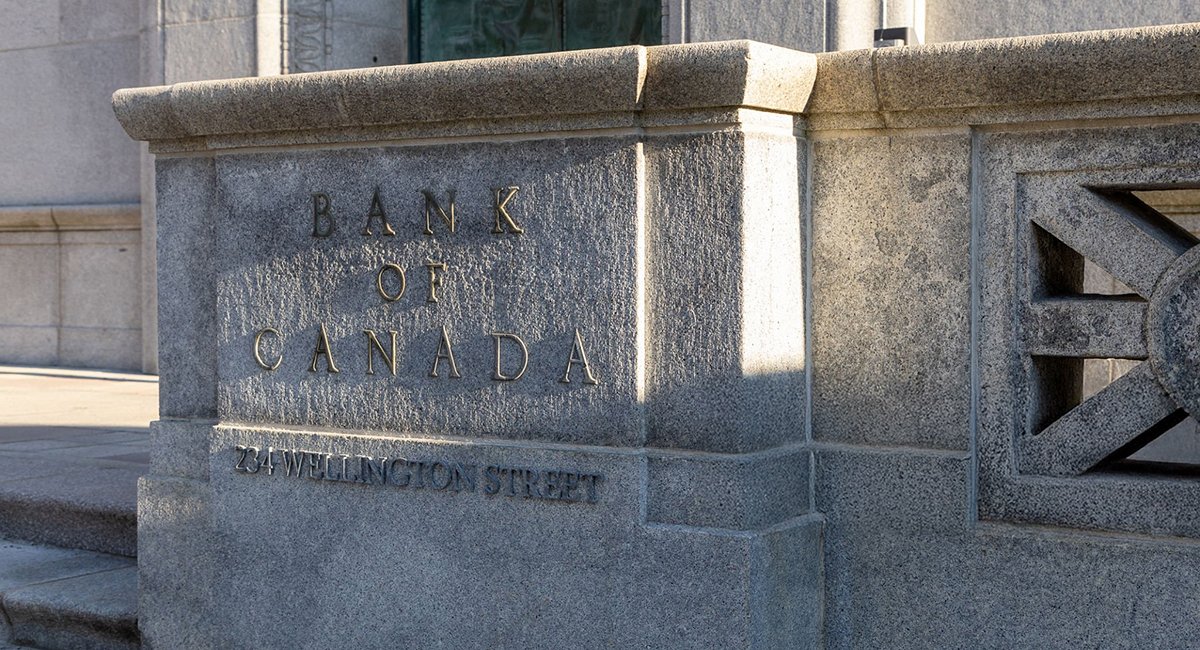
The Bank of Canada announces its interest rate decision at 9:45 a.m. Eastern this morning, alongside its quarterly Monetary Policy Report. Markets are pricing a near-certain hold at 2.25%, the sixth consecutive decision without a move since the easing cycle paused last October. Fifteen minutes later, at 10 a.m. Eastern, Federal Reserve Chair Kevin Warsh appears before the Senate Banking Committee for his first Humphrey-Hawkins testimony in that chamber, a day after delivering the same report to the House.
Both institutions are being asked to explain their reaction to the same input: a barrel of oil that fell for three straight weeks through July 6, then reversed the entire decline in two trading sessions once the Strait of Hormuz blockade resumed.
A Hold That Is Not the Interesting Part of the Morning
The rate decision itself carries little suspense. Reuters polling this month found economists near-unanimous that the Bank will hold at 2.25%, and futures markets price the probability of any move today at roughly 1%. The Monetary Policy Report is where the real information sits, because it will show whether Governing Council now treats this month's oil shock as a one-time price level shift, the framing it has used since February, or something more persistent.
That framing choice matters directly for Canadian portfolios. A Bank that reaffirms the transitory read is signalling confidence that today's headline inflation pressure fades on its own, which argues for holds continuing through the fall. A Bank that marks up its forecast meaningfully is signalling the oil shock has outlasted its patience, which opens the door to the hike scenario markets currently assign almost no probability.
The Number Behind the Hold
Canadian headline inflation has pushed above 3% in recent months, driven by gasoline costs tracking the war-elevated price of crude. But the Bank's preferred core measures, trimmed-mean and median CPI, were running near 2.1% in May, barely above the 2% target. That gap between headline and core is exactly the distinction the Bank has leaned on to justify staying on hold through a period when the unadjusted inflation print looks uncomfortable.
WTI's reversal this week complicates that argument without necessarily breaking it. Crude fell to $68.55 by July 6 as diplomatic optimism built, then rose 16.4% to $79.75 in the two sessions after the blockade resumed and the US struck Iranian targets for a fifth consecutive day. The June CPI print, due July 20, will not yet capture this week's move, which means today's MPR forecast is being built on an oil price that has already partly gone stale by the time markets read it.
Warsh's Awkward Set of Numbers
The Fed Chair arrives at the Senate with a genuinely harder story to tell than Governor Macklem's. US headline CPI fell to 3.5% in June from 4.2% in May, the first monthly decline in consumer prices since 2020. By the ordinary logic of central banking, cooling inflation argues for a less hawkish committee. The Federal Open Market Committee's June dot plot moved the opposite direction: nine of eighteen officials projected at least one hike in 2026, six of those projected two, and the committee's own year-end inflation forecast was revised up to 3.6% even as its growth forecast was trimmed to 2.2%.
Warsh himself declined to submit a rate projection at the June meeting, the first sitting chair to withhold one since the dot plot was introduced in 2012, a choice he has defended as reducing the risk that individual forecasts calcify into commitments. That decision shifts more of the market's attention onto exactly the kind of testimony he delivers today, where senators are expected to press him on why the committee hardened its stance in the same month incoming data softened.
The Transmission Back to Canadian Portfolios
The mechanism connecting both events to Canadian household finances runs through bond yields. The Government of Canada 5-year yield stood at 3.18% as of July 8, up from earlier in the year, and it is the 5-year yield, not the overnight rate, that fixed mortgage pricing actually tracks. A hawkish surprise from Warsh this morning would likely push US Treasury yields higher, and Canadian yields tend to follow US yields even when the Bank of Canada itself is standing still, a transmission channel that matters directly for the wave of Canadian mortgages renewing through 2026 and 2027.
Underneath both decisions sits a genuinely Canadian complication. Real GDP contracted at an annualized 1.0% in the fourth quarter of 2025 and a further 0.1% in the first quarter of 2026, two consecutive declines that meet the technical definition of a recession. Yet real gross domestic income, the measure that captures what the economy can actually afford to buy, rose over the same period, supported by stronger energy export revenue as global oil prices climbed. Canada's status as a net energy exporter means the same oil shock squeezing households at the pump is simultaneously padding national income, a tension the Bank's MPR forecast has to reconcile in a single set of numbers.
WTI's round trip over the past month captures the input both central banks are now pricing from very different starting points.
WTI fell for three weeks on diplomatic optimism before the blockade's reinstatement on July 13 reversed the entire decline in two sessions. The Bank of Canada last built its inflation forecast around the lower end of this range.
What to Watch in Both Appearances
For the Bank of Canada, the number that matters most is the MPR's updated inflation forecast for the back half of 2026, not the rate decision itself. A meaningful upward revision would be the clearest signal yet that the Bank's patience with the oil shock has limits. For Warsh, the number that matters is whether he reiterates the committee's hawkish June tilt or leaves room for the cooler CPI print to shift the calculus, since his own refusal to publish a rate projection means his verbal framing carries more weight than usual.