
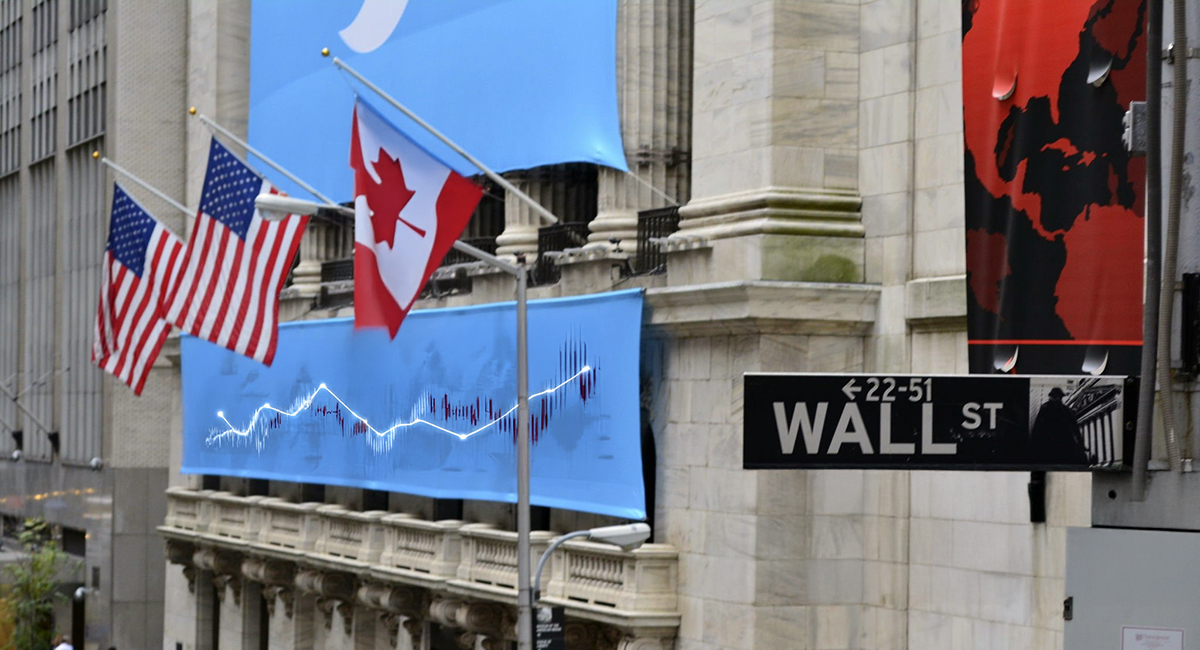
The TSX Composite closed at 35,406 Tuesday, up 0.43%. That gain followed a 0.1% dip Monday, meaning Toronto's benchmark moved inside a range of well under a percentage point on both sides of a week that saw Wall Street whipsaw far more violently in both directions.
A Much Calmer Ride Than Wall Street's
Monday was rough in New York. The S&P 500 fell 0.79%, the Dow dropped 0.26%, and the Nasdaq lost 1.55% as a selloff in semiconductor stocks compounded renewed Iran war fears. Micron fell 4.3%, Nvidia 3.5%, Sandisk 12.6%, AMD 4.2%, and Intel 6.1%, all pressured by concerns that AI hyperscalers could pull back on infrastructure spending.
Tuesday reversed most of it, but not cleanly. The S&P 500 gained 0.38% and the Nasdaq jumped 0.90% as chip stocks rebounded and a softer than expected US CPI print eased near-term rate-hike anxiety. The Dow limped to a 0.02% gain, held back by IBM, which fell roughly 25% after warning its second-quarter profit would miss estimates on weaker software and infrastructure demand. Software peers Workday, Salesforce, and Adobe fell 9%, 6%, and 5% respectively in sympathy.
Why the TSX Didn't Feel Any of It
The TSX Composite has no equivalent exposure to either side of that story. Toronto's benchmark carries minimal weight in enterprise software or memory chip manufacturing, the two sectors that drove Monday's selloff and Tuesday's partial recovery in New York. What it does carry heavily is energy and financials, and both had a comparatively uneventful week by comparison, moving with the oil price rather than against it.
WTI is the actual volatility story this week, not any equity index. Crude rose 9.42% Monday and a further 2.19% Tuesday, a two-day move larger than anything in either the TSX or the major US benchmarks. The TSX's energy weighting means that move showed up as a tailwind rather than the kind of cross-asset confusion Wall Street had to process alongside its own sector-specific earnings shocks.
The TSX's range stayed narrow across both sessions even as WTI and the VIX swung sharply in opposite directions.
The TSX moved in a narrower range than the Nasdaq on both days this week, even as WTI and the VIX swung far more sharply than any equity index shown.
The Bank Earnings Read-Through
Tuesday's US bank earnings were uniformly strong. JPMorgan posted its highest quarterly profit on record. Bank of America and Wells Fargo both beat estimates. Even so, JPMorgan fell 2.5% and Bank of America dropped 0.8% on the day, as broader risk-off sentiment from the Middle East and AI capex concerns outweighed the earnings beats. Wells Fargo sank 2% despite its own beat.
That disconnect, strong fundamentals overridden by macro sentiment, is worth watching as Canadian banks approach their own fiscal third-quarter reporting later this summer. If US banks can post record profits and still trade lower on the day, Canadian bank earnings will need more than a clean beat to move the TSX financials weighting, which remains the single largest sector driver of the index.
What to Watch Into the Close
Today's session carries its own dual catalyst: the Bank of Canada's rate decision and Monetary Policy Report at 9:45 a.m. Eastern, followed by Fed Chair Kevin Warsh's Senate testimony at 10 a.m. Neither is expected to move the overnight rate itself, but both carry the kind of forward guidance that has moved bond yields, and by extension bank and rate-sensitive stocks, more than the headline decisions themselves in recent sessions.