
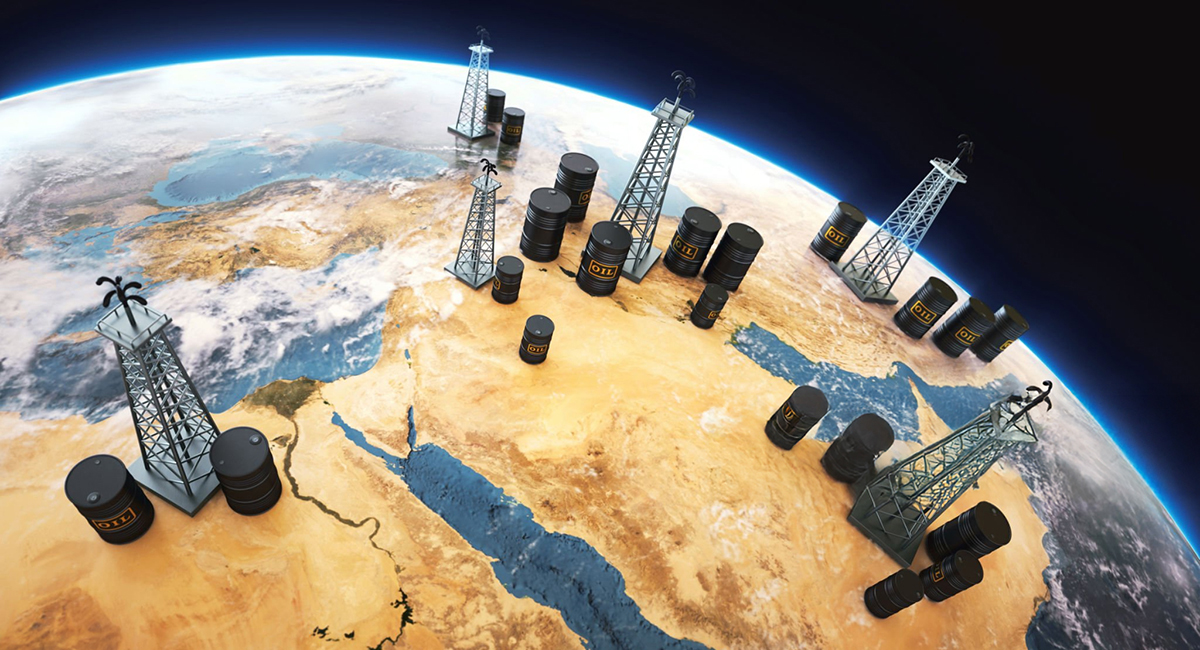
Iran's Revolutionary Guard issued a new threat Wednesday: halt energy exports from the entire Middle East, not just the traffic Iran itself controls through the Strait of Hormuz. "The export of oil and gas from the region will be either for everyone or for no one," the Guard said, hours after the US reimposed its naval blockade and struck dozens of targets across Iran in a seven-hour overnight operation.
From a Toll on Shipping to a Threat Against the Whole Gulf
For the four months since the war began, Iran's leverage has run through a single mechanism: its ability to disrupt traffic through the strait it borders, a waterway carrying roughly a fifth of the world's oil and gas trade. That is a transit problem. Markets have priced it as one, building a risk premium into Brent and WTI that reflects delay, insurance costs, and the physical danger to individual tankers, not the loss of actual production.
Wednesday's threat is a different mechanism entirely. Iran does not control oil production in Saudi Arabia, the UAE, or Kuwait. A threat to halt "everyone's" exports is not a claim about chokepoint control, it is a claim about the Guard's capacity or intent to strike production and export infrastructure directly, inside countries Iran is not formally at war with. The US strikes that followed hit an Iranian army barracks, killing at least seven troops and wounding more than 260, the most severe single Iranian casualty toll reported since the blockade resumed. Separately, Kuwait reported damage to an offshore drilling platform, the first direct hit on actual energy infrastructure, as opposed to a tanker or a shipping route, in weeks.
The Unclaimed Strikes Are the Detail Worth Watching
Hours after the US said it had ended its own strikes Tuesday night, explosions hit four locations in the Iranian city of Bushehr and were reported separately in Ahvaz and Bandar Abbas. No one has claimed responsibility. Iranian state media has raised the possibility that Gulf Arab states are retaliating against Iran directly without saying so publicly, a claim consistent with Jordan shooting down three incoming Iranian missiles and Kuwait reporting its own navy personnel wounded by Iranian fire this week.
If accurate, that reframes the conflict's base case. The current base case has been a bilateral US-Iran confrontation over a specific waterway, with Gulf Arab states as exposed bystanders. Unclaimed strikes from inside the Gulf would mean at least some of those bystanders have quietly become participants, which raises both the odds and the speed of a broader regional escalation beyond what markets are currently pricing.
What Monday's Market Reaction Shows About What Is Actually Priced
The clearest evidence that markets are still treating this as a contained, transit-specific shock sits in how selectively Monday's session reacted. Oil and volatility repriced sharply: WTI rose 9.42% and the VIX jumped 14.17% that session. But the TSX Composite fell just 0.1%, and Canadian financials were barely touched, with Brookfield down 0.9%.
Canadian energy producers benefited directly. Cenovus rose 4.7%, Suncor gained 3.5%, and Canadian Natural Resources added 3.1%, all tracking the oil move. Gold mining names moved the opposite direction as gold itself fell 2.61% on the day: Agnico Eagle down 2.2%, Barrick down 2.1%, Wheaton Precious Metals down 2%, and Franco-Nevada down a sharp 8.4%, the widest single move of the session.
Monday's session shows exactly which assets absorbed the shock and which did not.
Oil and volatility repriced sharply the same day gold miners fell and the TSX Composite barely moved, showing the market treating this as a commodity-specific shock rather than a broad one.
The Base Case Versus the Tail Risk for Canadian Portfolios
The base case remains what it has been through three prior escalation cycles since February: a transit-risk premium that lifts Canadian energy producers, pressures gold miners on Fed-hawkishness expectations, and leaves the broader TSX largely untouched. Brent's move above $85 this week, more than 15% above where it sat before this month's re-escalation, fits that base case. It remains well below the nearly $120 the conflict reached at its most severe point in the spring.
The tail risk is narrower but more consequential: a genuine shift from transit disruption to production disruption, where Gulf Arab exporters beyond Iran see their own infrastructure targeted or their own militaries drawn into direct exchanges. That scenario would not simply extend the current oil rally, it would risk the kind of physical supply loss that pushes crude toward its wartime peak and drags global growth down with it, a combination that would hurt the broader TSX and Canadian exports far more than a higher oil price alone would help the energy sector. Kuwait's drilling platform and this week's unclaimed strikes are the first concrete data points suggesting that shift, not confirmation that it has happened.