
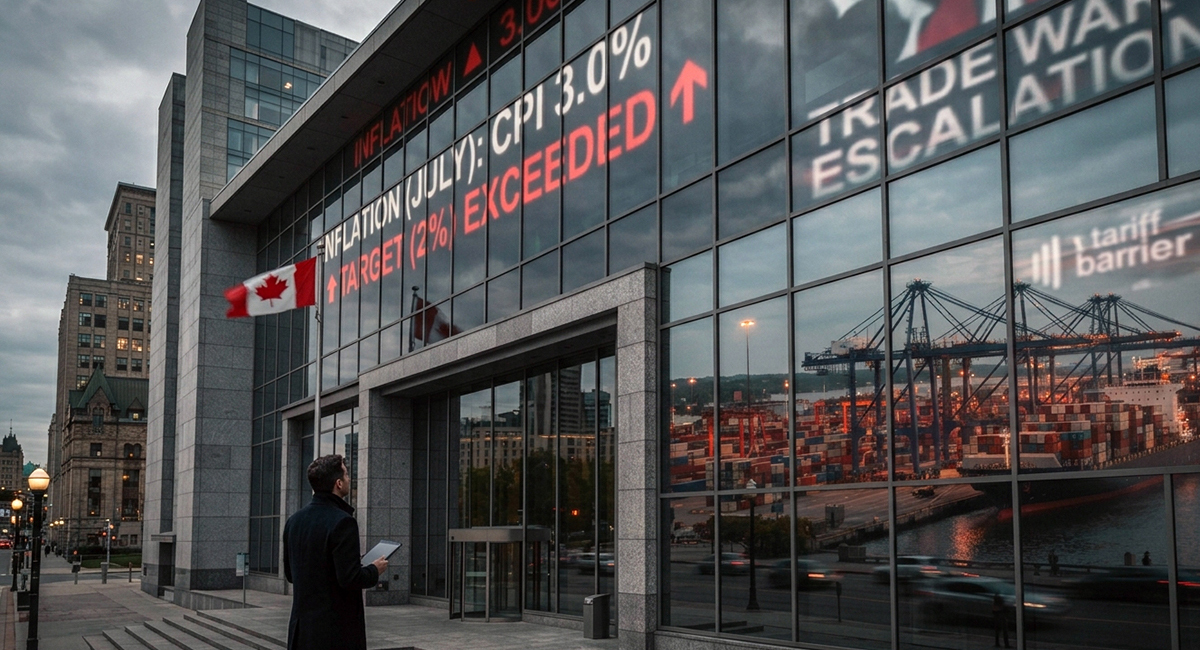
The Bank of Canada holds its policy rate at 2.25% on Wednesday, according to all 35 economists surveyed in a Reuters poll conducted the week of August 24. Bond markets agree: futures pricing assigns only a 3% probability to a hike. This would be the seventh consecutive hold, the longest stretch of unchanged policy since the Bank began cutting from 5.00% in June 2024.
The case for holding is not the same as the case for comfort. July's Consumer Price Index came in at 3.0% year over year, up from 2.8% in June, while the escalating Canada-U.S. trade war threatens the growth side of the mandate at the same time. The Bank is being asked to fight inflation and support growth with the same single tool, in opposite directions.
The Trade War Is Doing Half the Bank's Job
Doug Porter, BMO's chief economist, framed the bind directly: "The trade battle really does darken the growth outlook. Unless that's resolved, I think that's really what they've got to focus on, first and foremost." A weaker growth outlook is normally the Bank's cue to cut, not hold.
What is keeping the Bank on hold instead of cutting is the inflation side of the same picture. Core measures, which strip out volatile food and energy prices, ran at 1.9% year over year in July, comfortably inside target. But headline CPI at 3.0% is the number households and wage negotiations respond to, and it has moved the wrong way for two straight months.
Two Banks See This Differently
National Bank and Scotiabank broke from the consensus, forecasting the Bank will hike to 2.50% in October and to 2.75% by year-end, a view no other major Canadian bank shares. Their argument rests on the same CPI print everyone else is looking at: if headline inflation keeps climbing while the labour market holds up, the Bank's inflation mandate could force its hand regardless of the trade war's drag on growth.
This is a minority view, not the base case. But it is the kind of dissent worth tracking, because it identifies the exact data point, a further upside CPI surprise in the August or September reading, that would force the consensus to move.
The chart below traces the policy rate through every decision since the cutting cycle began, and shows how unusual six consecutive holds actually is against that recent history.
Nine consecutive rate cuts between June 2024 and October 2025 brought the policy rate from 5.00% to 2.25%. The Bank has held at that level through six meetings since October 2025.
The Mortgage Renewal Wall Meets a Stalled Rate Path
Roughly a third of Canadian mortgage holders face renewal by the end of 2026, most of them locking in five-year terms that originated during the 2020-2021 low-rate period. Ratehub's Jamie David noted that a prolonged trade conflict that weakens the economy could push bond yields, and consequently fixed mortgage rates, lower as recession concerns grow, even without a Bank of Canada cut.
That is the mechanism worth watching more closely than the overnight rate itself this week. Five-year fixed mortgage pricing tracks Government of Canada five-year bond yields, not the policy rate directly, and those yields can move on trade-war and recession expectations well before the Bank changes its own setting.
A hold on Wednesday keeps variable-rate mortgages exactly where they are. It does not resolve whether fixed rates drift lower on trade-war growth fears or higher on the same inflation print that has National Bank and Scotiabank forecasting a hike. Both outcomes are live, and they point in opposite directions for the renewal wall.