
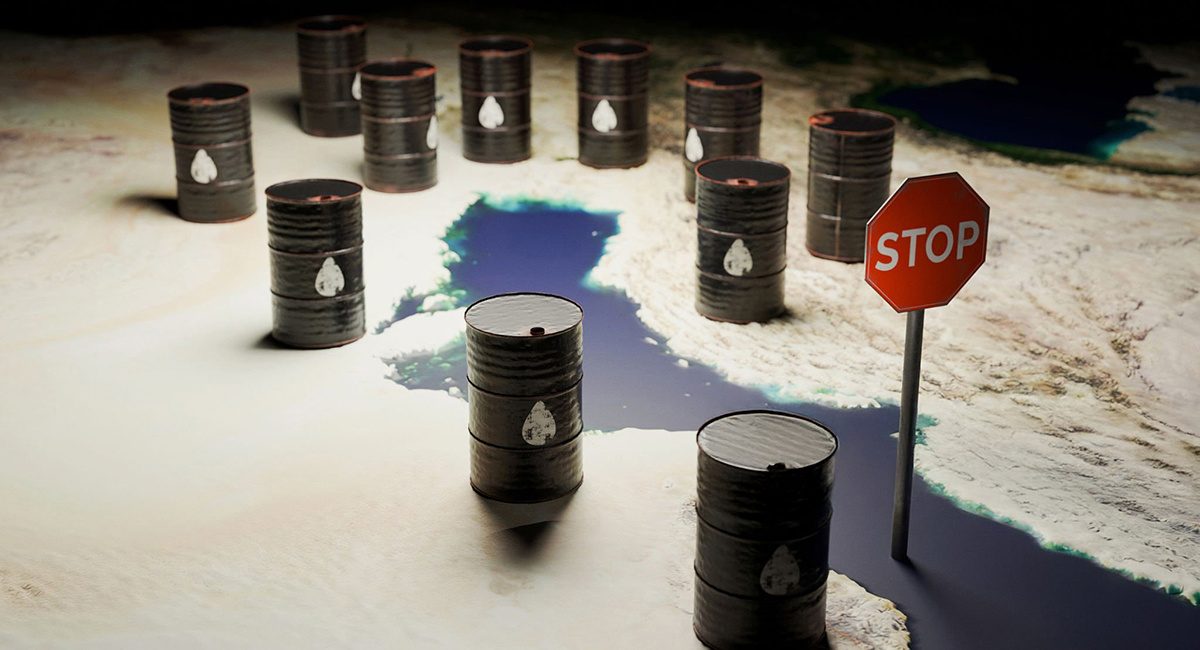
Two oil tankers, one Saudi-owned and one South Korean-owned, were struck by unidentified projectiles in the Strait of Hormuz late Monday. Hours earlier, US forces struck Iranian positions on Larak Island, and Iran retaliated against the King Hussein and Al Azraq bases in Jordan. It was the first direct US-Iran exchange in more than a month. WTI crude rose 2.3% Tuesday to $87.75 a barrel; Brent climbed to above $92.
How a Tanker Strike Becomes a TSX Story
The mechanism is direct and it does not require the strait to close outright. Weekly transits through Hormuz have fallen to roughly 107 from a pre-war norm of 130, on a route that carries close to 20% of global oil supply. Every incremental disruption adds a few dollars of risk premium to the benchmark price, and Canadian energy producers, priced globally but valued domestically, capture that premium directly.
The TSX energy sub-index has tracked WTI closely through prior legs of this conflict, and the Canadian dollar, still a petrocurrency in its trading behaviour, tends to firm alongside oil even as broader risk appetite weakens on the same headlines. A Canadian portfolio with standard benchmark energy weight is more exposed to Monday night's headlines than a comparable US portfolio, in both directions.
Base Case Versus Tail Risk
The conflict is six months old, tracing back to the February 28 Operation Epic Fury strikes that killed Iran's Supreme Leader and triggered a full closure of the strait by early March. Brent hit $126 that month, a genuine supply-shock price. What followed was a April ceasefire, a US Navy blockade, brief reopenings, and repeated re-closures, a pattern that has taught markets to treat each new incident as a fading premium rather than a repeat of March.
Saul Kavonic of MST Financial captured the shift in read: "Hopes of a near-term deal to open the strait have faded as the conflict appears back on an escalatory trajectory." Tony Sycamore of IG Markets was more direct on the near-term price path: "I think after the latest skirmish, the path of least resistance for oil is higher in the short term."
The base case is that this incident follows the pattern of the incidents since April: a premium that builds over days and fades over weeks without a full closure. The tail risk is that direct strikes on Iranian territory and Iranian retaliation against US-aligned bases in Jordan represent a different order of escalation than a tanker harassment campaign, closer in kind to the events that preceded March's closure than to the skirmishes since.
The chart below tracks WTI's daily close through August and into this week, showing how much of the current move sits on top of a month that had already been drifting higher before Monday.
WTI closed August in a $75 to $87 range as the Strait of Hormuz conflict, six months into its February 28 start, cycled between quiet stretches and skirmishes. Tuesday's move sits on top of a month that was already drifting higher.
The Timing Collision With Wednesday's Rate Decision
The Bank of Canada delivers its rate decision Wednesday against a backdrop of July inflation already running at 3.0%, above the midpoint of its target range. An oil-driven cost impulse arriving the day before that decision does not change Wednesday's outcome, which every economist surveyed expects to be another hold, but it sharpens the argument of the minority of forecasters already calling for a hike later this fall.
For a Canadian portfolio, the same headline that lifts energy holdings and the loonie also feeds into the inflation side of the Bank's calculus that has kept it from cutting despite a trade war weighing on growth. The two effects do not cancel out in a portfolio the way they might appear to on a macro chart; they show up as sector-specific strength sitting alongside broader rate uncertainty.