
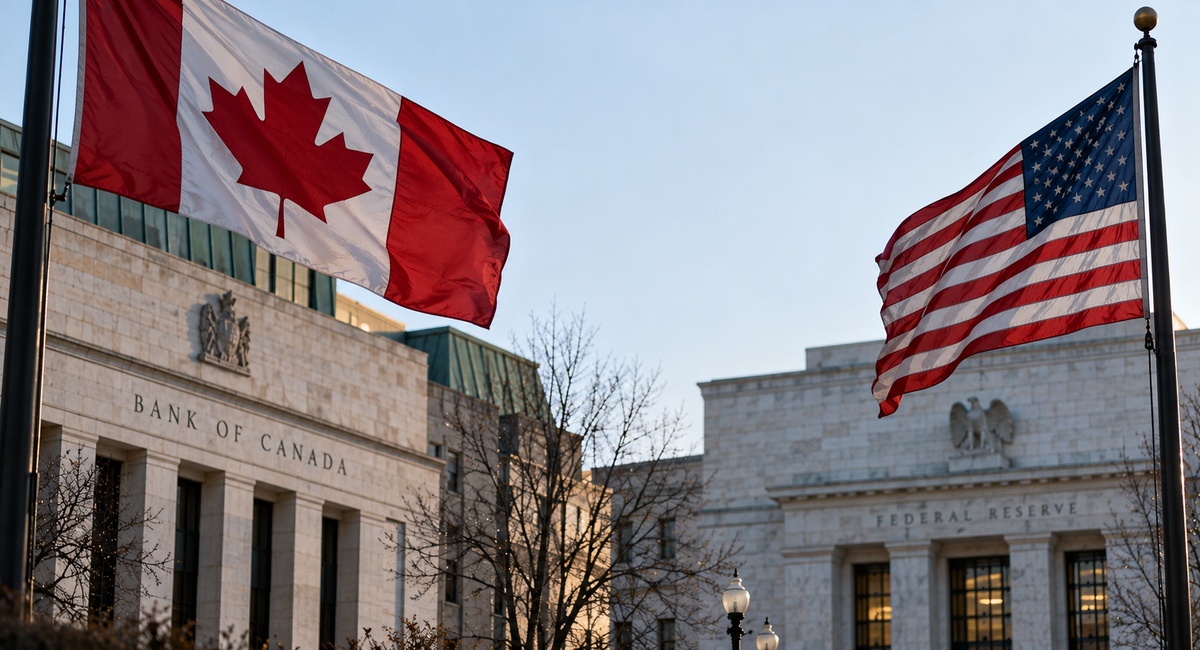
The Bank of Canada raised its overnight rate to 2.50% today, and the two-year Government of Canada yield rose with it. The market did not treat the hike as the end of the job. It treated it as a down payment.
The morning Economy framework was a two-year yield more than 110 basis points above the policy rate. Two further facts change what it means: how closely that yield follows its American counterpart, and the Federal Reserve decision that arrived this afternoon.
A Hike That Left the Market Asking for More
The two-year closed Tuesday at 3.36%, 111 basis points above the old 2.25% rate. By mid-afternoon Wednesday, Reuters data put it at 3.413%, after an earlier high of 3.441%. That is 91 basis points above the new rate. The Bank moved 25 basis points, and the two-year moved about 5 in the same direction.
Governor Tiff Macklem said the Bank would "proceed carefully" while allowing that more increases could be needed. A yield 91 basis points above the policy rate reads, on a simple calculation, as a little more than three further quarter-point moves, an upper bound given term premium.
September CPI-trim was 1.8%, below the 2% target, and Canada lost 68,000 jobs. The data do not obviously ask for that much.
The Canadian two-year has sat 93 to 115 basis points above the policy rate since September 10, and the hike leaves it at 91, just under the floor of that band.
The Bank changed its 2-year benchmark bond on October 23, when the series rose 11 basis points. The dashed final segment uses a Reuters mid-afternoon yield of 3.413%, not a Bank of Canada close.
The Canadian Curve Has Been Following the American One
Since August 4 the Canadian two-year has risen 53 basis points, from 2.83% to 3.36%. The U.S. two-year has risen 50, from 4.20% to 4.70%. Daily changes in the two yields have a correlation of 0.68 over that stretch, an HDQ calculation from Bank of Canada and Federal Reserve Bank of St. Louis data.
A rise driven by Canadian conditions would pull the two curves apart. This one did not. The spread was 137 basis points in August and 134 on Tuesday. The Bank cited energy prices for the hike, and energy is a shock both economies share: Brent traded above US$115 in the morning after a Houthi-claimed strike on a Saudi refinery, and WTI stood at US$101.69 late in the session.
The spread between U.S. and Canadian two-year yields has stayed inside 117 to 162 basis points and ended Tuesday almost exactly where policy rates now put it.
Dashed lines mark the distance from the 3.875% Fed funds midpoint to the Bank of Canada rate: 162.5 basis points at 2.25% and 137.5 at 2.50%.
Two Fed Dissents Put the Old Gap Back in Play
The Fed held at 3.75% to 4.00% on a 10 to 2 vote. Governor Lisa Cook and Cleveland Fed President Beth Hammack dissented, both preferring a quarter-point hike. The midpoint of that range sits 137.5 basis points above the new Bank of Canada rate, down from 162.5 before this morning. One Fed hike restores the old figure.
The bond market had already moved to the new gap: the spread sits within four basis points of 137.5 and 28 below its October 9 peak of 162. What remains is a symmetry. The market asks the Bank for 91 basis points of further tightening and the Fed for roughly 83, using the Tuesday U.S. two-year of 4.70%. Canada is priced almost as hawkishly as the United States.
The currency gave no credit for the hike. The Bank of Canada daily rate was 1.4036 per U.S. dollar against 1.4038 on Tuesday, and the S&P/TSX Composite closed at 36,265.09, up 0.3%, inside the 35,584.50 to 36,325.00 range of its last twelve closes.
The change is in where to look. The Bank has said it will proceed carefully, and two Fed voters have asked their committee to move. On the pattern since August, the next large move in Canadian short rates is more likely to be set by the U.S. data calendar than by anything said in Ottawa.