
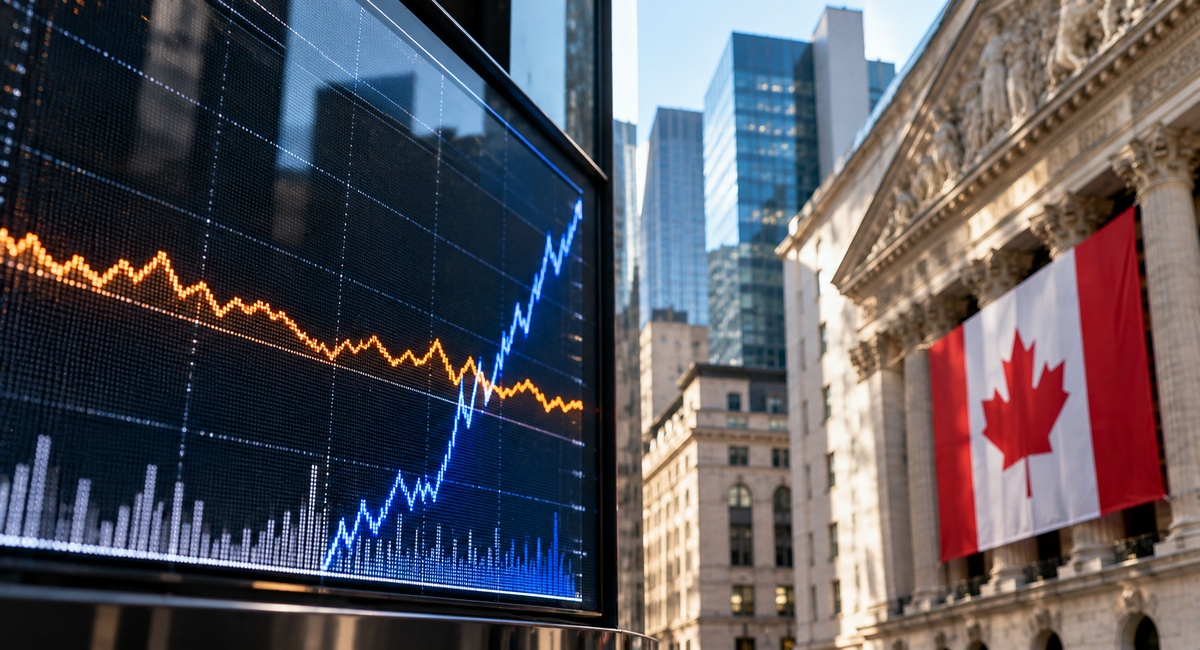
The S&P/TSX composite closed at 36,171.5 on October 27, up 227.3 points or 0.63%. It has closed between 35,584.5 and 36,325.0 in each of the last 11 sessions, a range of about 2%. Over the same sessions Brent crude rose 7.7%, from US$105.69 to US$113.88, so the index has not followed oil higher.
The Bank of Canada announces its rate decision at 9:45 a.m. ET today, and the U.S. Federal Reserve also decides. The TSX enters both decisions in the middle of its range, 2.1% below its August 25 close of 36,957.6, the highest close of the past six months.
Weekly candles show a 7.0% advance since April 27 that stalled after the August high, and the 10-week moving average of weekly closes has slipped from 36,127.2 in the week of October 5 to 35,967.6. The index closed 0.6% above that average on Tuesday.
Weekly candlesticks for the S&P/TSX composite from the week of April 27 to the two sessions of the week of October 26, with weekly volume and a 10-week moving average of closes. The shaded box spans the 11-session closing range from October 13 to 27, and the dashed line marks the August 25 close of 36,957.6.
Oil Is Up and the Index Is Flat
The two-week range is narrow for a stretch in which Brent made its highest close in the three-month series. Brent reached US$116.72 on October 23, and the TSX fell 185.27 points to 35,788.18 that day, according to The Canadian Press. December crude rose US$3.80 to US$103.27 and December gold fell US$52.50 to US$4,007.90. The day before, the index had fallen 351.5 points, or 1.0%, to 35,973.5, from 36,325.0, the top of the current range.
The Canadian Press attributed the decline to three things: concern that technology companies are overspending on artificial intelligence, higher oil on fears that hostilities could resume after the U.S. midterm elections, and rising odds of a Bank of Canada hike. Allan Small, senior investment adviser at iA Private Wealth, said, "it would be foolish for the Bank of Canada to hike interest rates."
Oil should help a market with a large energy sector, but the index fell on a day when crude rose. The sources name AI spending and rate expectations as the offsets rather than any single sector.
The point for Canadian portfolios is that the TSX has not been a pure oil trade in October. The index has gained 0.5% since October 13, against 7.7% for Brent.
What Moved on Tuesday
The index rose on materials. At 12:31 p.m. ET, materials stocks were up 1.3% on copper gains, information technology was up 0.2% and energy was down 1.1% as oil turned lower, according to ad-hoc-news. Celestica rose 10.0% after beating third-quarter revenue and profit estimates.
Sector detail is limited to the midday snapshot. Materials led, technology added a small gain and energy lagged, which is the opposite of the pattern an oil rally would normally produce. The close of 36,171.5 was about 70 points above the 12:31 p.m. level of 36,099, so the index gained further into the afternoon.
Gold recovered. December gold was at US$4,070.40 an ounce in late-morning trading, up US$32.00, according to The Canadian Press, and the front-month contract closed at US$4,074.60 in the Yahoo Finance data. That is 1.7% above the October 23 close of US$4,007.90.
American markets moved with Canada. The S&P 500 closed at 7,722.60, up 0.60%, and the Cboe VIX fell to 17.52 from 19.45 on October 23. The Canadian dollar traded at 71.25 American cents in late-morning trading, against 71.30 on Monday.
Volume was ordinary. Tuesday trading of 247.0 million shares was 5% below the 20-session average of 260.9 million, which fits an index waiting for the central banks rather than repositioning.
Two Decisions Today and What Is Priced
The Bank of Canada decision comes first, at 9:45 a.m. ET. In a Reuters poll of 34 economists, 19 expect a quarter-point hike to 2.50%, and The Canadian Press reported odds of about 78% on October 23. A hike would be the first since July 2023, and Reuters reports it would bring higher bank lending rates and mortgage costs and slower economic growth.
A hike is therefore mostly priced, and the surprise is a hold. A hold at 2.25% would remove a rate-path risk from the index. A hike with guidance on a second move, which a majority of the economists in the Reuters poll expect before the end of March, would extend it.
The Federal Reserve decides the same day. Odds of a Fed hike fell last week, and The Canadian Press reported that any move is now more likely in December. The Bank of Canada matters more for the TSX, because it sets the cost of credit for the Canadian banks and borrowers in the index.
The second driver is the weekly count of ship attacks near Hormuz, which set a monthly record in October. Oil moves on that count, and the TSX has so far moved on other things.
Levels to Watch
The closing range gives the levels. The lower bound is 35,584.5, the October 14 close, and the upper bound is 36,325.0, the October 21 close. The 10-week moving average at 35,967.6 sits near the middle of that range.
A close above 36,325.0 would break the range to the upside, and the next reference is the August 25 close of 36,957.6, which is 2.1% above Tuesday. A close below 35,584.5 would leave the index 3.7% below that high.
The weekly candle of October 12 had a high of 36,462.5 and a close of 36,176.6. The current week closed at 36,171.5 after two sessions, almost exactly where the week of October 12 ended, which shows how little net progress the index has made in two weeks. Weekly volume was 1,237 million shares in the week of October 19 and 1,145 million in the shortened week before it, so neither side has drawn extra participation.
The HDQ base case is that the range holds through today, since the rate decision is mostly priced and the oil and rate drivers largely offset each other. A surprise in either direction, or a settlement or escalation in the conflict, is what would end it.