
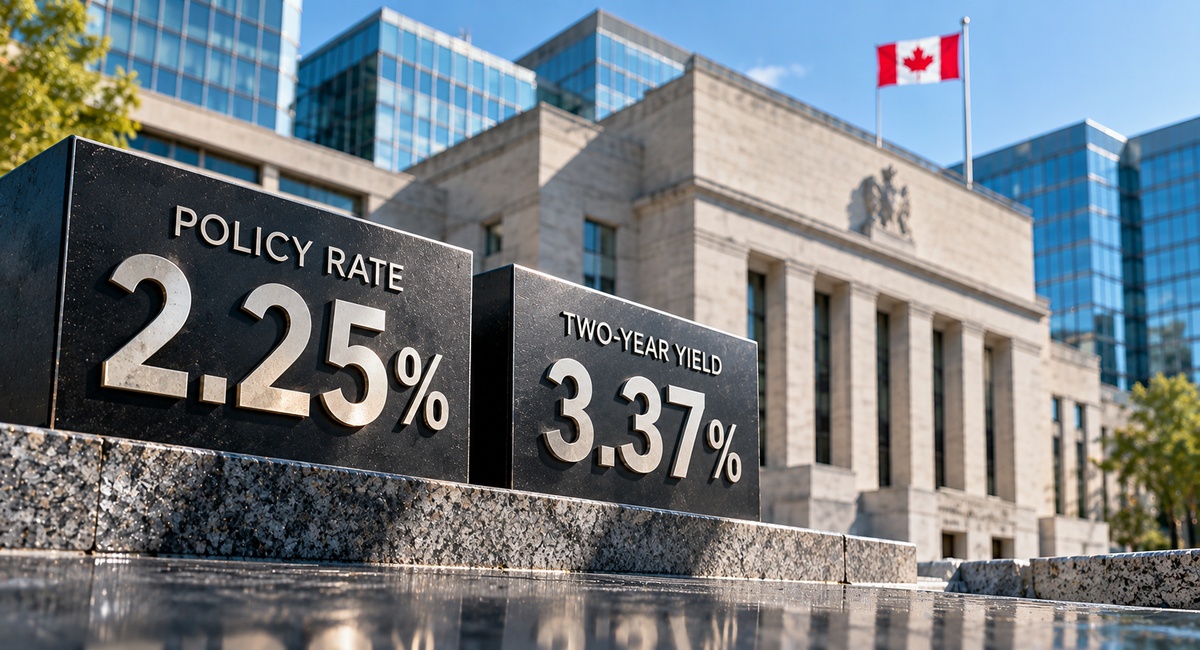
The Bank of Canada target overnight rate has stood at 2.25% since the October 2025 cut. The two-year Government of Canada yield closed Monday at 3.37%, 112 basis points higher. On October 31, 2025 the gap was 15 basis points.
The decision arrives today at 9:45 a.m. ET. In a Reuters poll of 34 economists conducted October 21 to 23, 19 expect a quarter-point hike to 2.50%. The previous poll found 80% expecting the rate to hold at 2.25% through the end of 2026.
Bond markets did not wait for the poll to change. From February 27 to October 26 the two-year yield rose 98 basis points, from 2.39% to 3.37%, and the five-year yield rose 91 basis points, from 2.67% to 3.58%. Over the same stretch the policy rate did not move at all.
Daily closes of the Government of Canada 2-year and 5-year benchmark yields and the Bank of Canada target overnight rate, 265 observations from October 1, 2025 to October 26, 2026. The shaded band is the gap between the 2-year yield and the policy rate. October 27 yields are not yet published.
A two-year yield reflects the expected path of the overnight rate over two years, plus other factors, so the gap is not a forecast of the decision today. It does show that the number most often quoted and the number used to price money are no longer close.
Anchoring Keeps the Old Number in the Room
Amos Tversky and Daniel Kahneman described anchoring in a 1974 paper in Science. They spun a wheel of fortune rigged to stop at 10 or 65 and asked participants to estimate the share of African countries in the United Nations. Median estimates were 25 for the group that saw 10 and 45 for the group that saw 65.
The number on the wheel had nothing to do with the question, and it still pulled the answers toward itself. People start from a salient value and adjust, and the adjustment tends to stop early.
Nicholas Epley and Thomas Gilovich tested why in a 2006 paper in Psychological Science. Adjustment is effortful, and people stop adjusting once they reach a value that feels plausible. The starting point is rarely wrong by much. It is simply the point from which the estimate never fully leaves.
Applied to rates, the implication is direct. If the overnight rate is the starting value, estimates of what money costs will drift toward 2.25% and stop short of where bond markets have been pricing it. The research describes a tendency across people, not a failing in any one of them.
A Policy Rate Is a Natural Anchor
The Bank of Canada overnight rate is about the most salient interest rate in the country. It is announced on a calendar, reported in every newspaper and attached to a single, round figure. For 12 months that figure has been 2.25%.
Anchors also work on professionals. Gregory Northcraft and Margaret Neale showed in a 1987 paper in Organizational Behavior and Human Decision Processes that real estate agents valuing a house were pulled toward its listing price, even though the agents said the listing price played no part in their estimate.
Mortgage borrowers face the same structure. The lowest variable rate sits at 3.43%, according to Ratehub.ca figures reported by MoneySense, and a quarter-point hike would lift it to about 3.7%. A borrower anchored on 2.25% sees a 0.25 point change. A borrower who has watched the two-year yield sees a move that began months ago.
Experience does not fully remove the effect. A borrower who renewed a mortgage in the past two years may be comparing today with a rate set when the two-year yield was near 2.4%, and the 2.25% overnight rate would look consistent with that memory.
Status Quo Bias and the Quiet Reference Point
William Samuelson and Richard Zeckhauser documented status quo bias in a 1988 paper in the Journal of Risk and Uncertainty. When a current option is presented as the default, people choose it more often than they do when the same option is presented as one of several alternatives. Standing still feels like a non-decision, even when it is a decision.
Kahneman and Tversky explained part of the reason in their 1979 Econometrica paper on prospect theory. Outcomes are coded against a reference point, and a loss against that reference point weighs more than an equal gain. If the reference point is a rate locked in at 2.25% or a portfolio value from last spring, the market move since February registers as a loss that has not yet been booked.
Fixed mortgage rates are typically priced off Government of Canada bond yields of matching term. The five-year yield stood at 2.70% on October 31, 2025 and 3.58% on October 26, 2026, an increase of 88 basis points. None of that movement required a decision from the Bank of Canada.
The measured facts are narrow. The overnight rate has not changed in a year, and the two-year and five-year yields have both risen by roughly 90 to 100 basis points since February 27. What households and investors do with those facts is a separate question, and the research cited here does not answer it.
Decision Day Compresses a Year Into One Number
Today the gap between the two numbers will be announced as a single outcome. A hike to 2.50% would narrow the gap to 87 basis points at Monday closing yields. A hold at 2.25% would leave it at 112. The yield data from Tuesday is not yet published, so both figures are approximate.
Behavioural research does not say which headline will register. It says that the headline will be read against a reference point, and that for many people the reference point is the policy rate they have heard for a year rather than the yield the bond market has been using.
If the Bank of Canada hikes, the policy rate moves toward the market. If it holds, the market has told a different story for eight months and the anchor remains. Either way, the 265 daily observations show the gap opening well before today.