
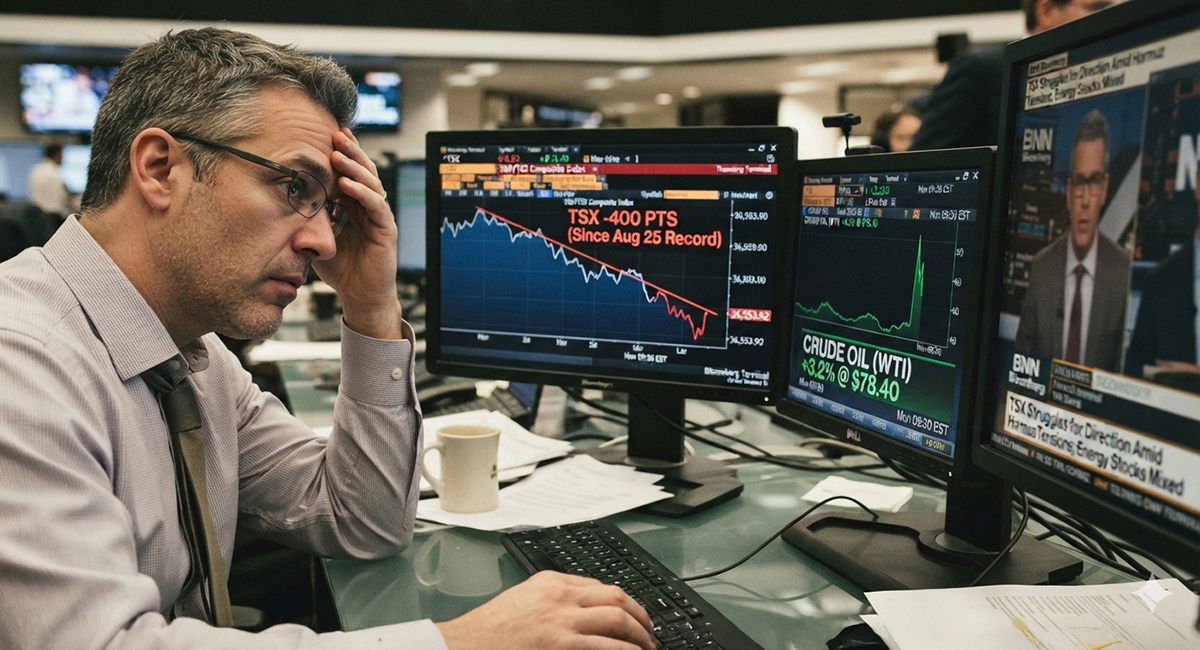
The TSX closed Friday at 36,553.92, down 280.33 points or 0.8%, its lowest level since August 20 and a third consecutive down session from the record close of 36,957.63 set August 25. The index has now given back roughly 400 points, or 1.1%, over three sessions. For the week, the TSX finished down 0.2%, its second straight weekly decline, despite all six major Canadian banks reporting stronger-than-expected quarterly earnings.
The index found support near 36,222 on August 20 before rallying to a record close on August 25, then retreating over three sessions on gold-linked mining weakness and an oil-driven pullback in energy names.
Why Both Sectors Fell on Different News
Mining names carried Friday's decline as gold dropped 3.2% on Federal Reserve Chair Kevin Warsh's Jackson Hole remarks, which pushed September rate-hike odds toward 57%. Agnico Eagle fell 3.8%, Barrick lost 3.1%, Wheaton Precious Metals retreated 2.6%, and Kinross shed 3.5%. Energy producers fell on a separate mechanism: WTI crude dropped as flows through the Strait of Hormuz increased and Iran and Oman agreed on a revenue-sharing framework for the waterway, a read markets treated as de-escalation. Canadian Natural fell 1.3%, Suncor lost 1.1%, and Imperial Oil shed 1%. Financials held up, supported by the week's earnings and Canada's 3.3% annualized second-quarter GDP print, its strongest pace in nearly two years.
What Reverses at Monday's Open
The de-escalation read behind Friday's energy weakness reversed hard over the weekend. US Central Command struck Iranian rocket launchers on Larak Island Sunday, the first American strike on Iranian territory in more than a month, and Iran retaliated against US bases in Jordan and the UAE. WTI crude was up more than 3% in Monday trading, with Brent above $91. That is a direct reversal of the exact mechanism that pulled Canadian Natural, Suncor and Imperial Oil lower Friday, and it sets up energy as the sector to watch at the open.
Gold's setup is less clean. The metal was essentially flat Monday morning near $4,454, still absorbing Friday's Fed-driven drop rather than finding a fresh safe-haven bid from the weekend's military exchange. If mining names track gold rather than the broader geopolitical headline, Friday's mining weakness may not reverse alongside energy's. The two sectors that fell together Friday are positioned to diverge at Monday's open.
The Setup Into Wednesday
US markets closed a mixed week Friday: the S&P 500 fell 0.25% to 7,711.76 and the Nasdaq dropped 0.52% to 26,402.42 on Warsh's remarks, while the Dow held nearly flat at 53,559.99. All three still posted weekly gains. The US 10-year Treasury yield jumped to 4.72% on the hawkish read, and Government of Canada 10-year yields held at 3.73% Monday, near the more than two-year high touched in late August. The Bank of Canada decides Wednesday at 9:45 a.m. ET, with a hold at 2.25% priced as close to certain. Between now and then, energy's reversal and gold's stall are the two threads most likely to move the TSX independent of anything the Bank itself does.