
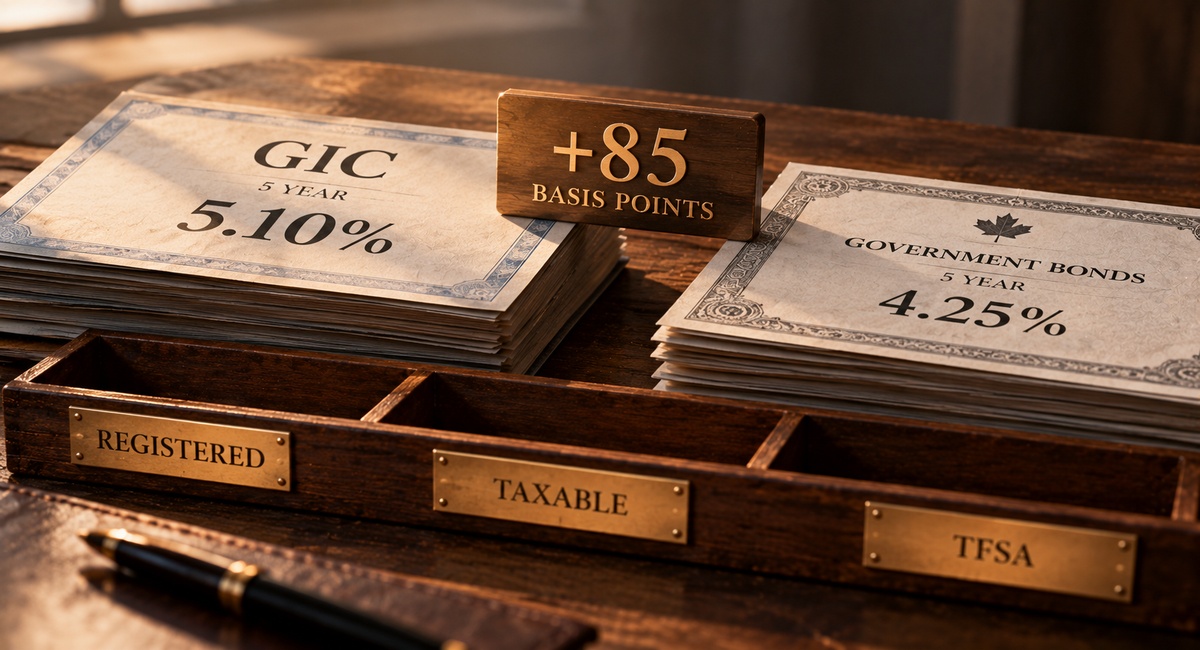
The Government of Canada 5-year yield closed at about 3.60% on October 1, up 0.88 percentage points from a year earlier, according to Trading Economics. The best 5-year guaranteed investment certificates are paying more. On September 30, WOWA.ca listed 12 institutions offering between 4.17% and 4.45% on a 5-year non-redeemable GIC, led by Haventree Bank at 4.45%.
That is a premium of 57 to 85 basis points over a government bond of the same term. For Canadian savers and retirees, the rate is only the first half of the decision. The second half is the account that holds the certificate, because interest is taxed in full at the marginal rate while capital gains are taxed on one-half.
All 12 of the best 5-year GIC rates sit between 57 and 85 basis points above the Government of Canada 5-year yield of 3.60%, with the top rate at 4.45%.
Rates are for non-redeemable 5-year GICs as listed on September 30, 2026, and the premium excludes any difference in liquidity between a GIC and a government bond. The stems run from the Government of Canada 5-year yield to each rate.
The Account Decides What the Interest Is Worth
Interest on a GIC held in a non-registered account is taxed every year as it accrues. The 2026 federal rates are 14% on income to $58,523, 20.5% to $117,045, 26% to $181,440, 29% to $258,482 and 33% above that, before provincial tax, according to the Globe and Mail. On $100,000 invested at 4.45%, interest of $4,450 attracts $1,157 of federal tax at 26% and $1,291 at 29%.
The same certificate in a TFSA produces interest that is not taxed, including on withdrawal. The 2026 TFSA limit is $7,000, bringing cumulative room to $109,000 for someone eligible since 2009. In an RRSP, the interest is deferred until withdrawal, and contributions for the 2026 tax year are allowed until March 2, 2027, up to the $33,810 dollar limit. FHSA contributions must be made by December 31 to claim a 2026 deduction.
Zero-coupon strip bonds and treasury bills are taxed differently from coupon bonds, with the discount treated as interest. A coupon bond bought below par and held to maturity generally produces a capital gain on the difference, taxed on one-half, rather than interest income. A lower-coupon bond can therefore shift part of a return to the capital gains inclusion rate.
Falling Bond Prices Can Create a Tax Asset
The rise in yields that lifted GIC rates also pushed down the price of existing bonds. The 10-year US Treasury yield touched its highest level since 2002 on October 1, according to Reuters, and the Canadian 5-year yield is 0.88 percentage points above its level a year ago. A bond held in a non-registered account at a price below its cost can be sold to realize a capital loss. Losses inside an RRSP, TFSA or FHSA cannot be claimed.
A capital loss offsets capital gains in the same year. Any excess can be carried back to any of the three preceding years or forward to any future year, according to Scotia Wealth Management. The last day to trade for settlement in 2026 is December 30.
The superficial loss rule limits the move. If an identical property is acquired in the 61-day window from 30 days before to 30 days after the sale and is still held 30 days after it, the loss is denied. The rule extends to repurchases by a spouse and to purchases inside an RRSP or TFSA, which is the trap that catches investors who sell a bond in a regular account and buy it back in a registered one.
Three Dates Frame the Decision
The planning question for a saver with maturing cash is which account should hold the certificate before the money is committed for five years. For a holder of bonds below cost, it is whether a loss realized by December 30 offsets gains already taken this year. The dates are December 30 for non-registered loss realization, December 31 for FHSA contributions deductible against 2026 income, and March 2, 2027 for RRSP contributions against 2026 income.