
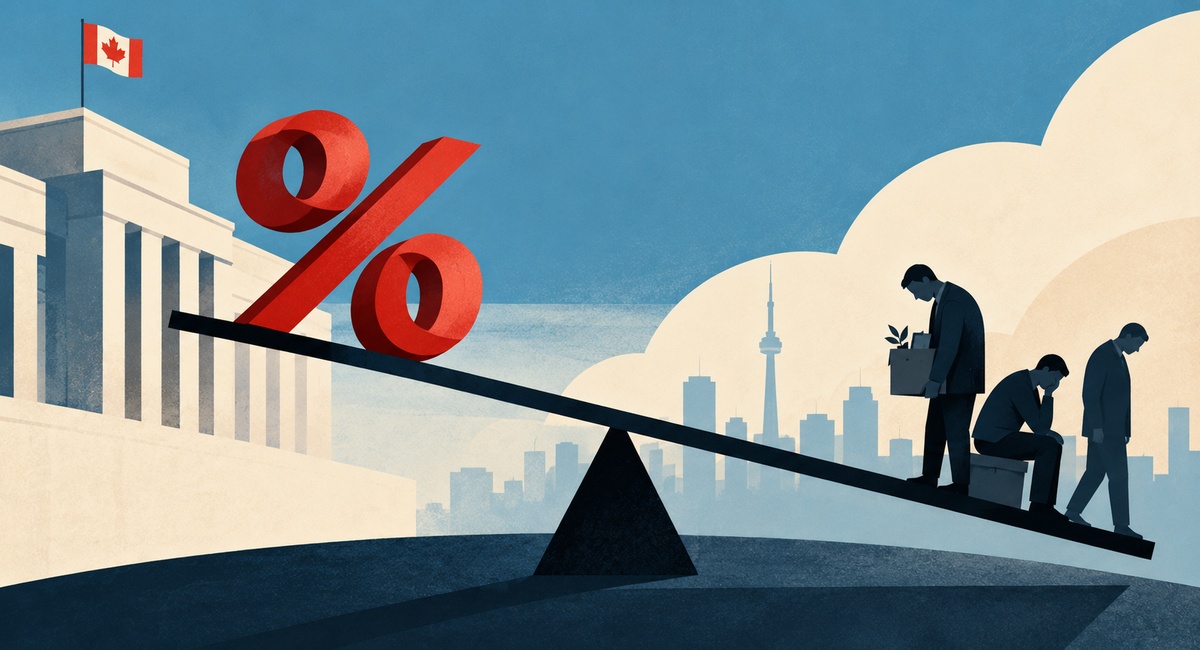
The Government of Canada two-year yield closed at 3.21% on October 16, 96 basis points above the 2.25% policy rate, one week after Statistics Canada reported that the economy lost 68,300 jobs in September. The bond market is pricing a tightening cycle into a labour market that has now contracted for two consecutive months.
The September decline followed a loss of 41,700 jobs in August and compares with a consensus forecast of a gain of about 9,200. Employment is down 41,200 jobs so far in 2026, against a gain of 211,300 over the same period of 2025. The unemployment rate rose to 6.5% from 6.4%.
What the Labour Report Actually Contained
Losses were concentrated in the public sector, particularly health care, social assistance and education, where cuts to international student permits reduced demand. Manufacturing, which is partly exposed to U.S. tariffs, lost 12,700 jobs, and employment among those aged 15 to 24 fell by 48,000. Job losses were split almost evenly between full-time and part-time work.
The participation rate fell 0.2 points to 64.8%, its lowest level in 29 years outside the pandemic, a decline attributed mainly to an aging population and slower immigration. That matters for the policy read: a shrinking labour force limits how much slack a rising unemployment rate represents. Average hourly wage growth for permanent employees accelerated to 2.3% from 2.0%.
Royce Mendes, head of macro strategy at Desjardins, said after the report that the weaker labour market made a hold likely at the October 28 decision, and that higher energy prices "will begin feeding other categories of inflation this fall," which could push policymakers to tighten soon.
Why Yields Did Not Follow Jobs Lower
On the day of the report the two-year yield fell 6 basis points to 3.18% and the ten-year fell 7 basis points to 3.86%. Both have since recovered part of the move, and the two-year remains 10 basis points above its September 2 level of 3.11%. Yields are well below the September 23 peaks of 3.40% and 3.99%, so the market has taken some of the tightening premium out, but not most of it.
Daily closing yields on Government of Canada benchmark bonds, 30 trading days to October 16, 2026. The Bank of Canada policy rate has been 2.25% since October 2025.
September consumer prices complicate the picture. Headline CPI rose to 3.1% from 3.0%, with gasoline up 27.8% from a year earlier, while inflation excluding gasoline eased to 2.2%. The Bank of Canada preferred core measures were lower: CPI-trim at 1.8% and CPI-median at 1.9%.
Forecasters have split on what that means. BMO, RBC and Desjardins now call for a hike to 2.5% on October 28. Michael Davenport of Oxford Economics said the print was slightly softer than expected and raised the odds of a hold. Avery Shenfeld of CIBC said "We have inflation in gasoline prices, which every Canadian already knew," adding that trend measures excluding gasoline are running near 2%.
The Transmission to Mortgages and the October 28 Test
The five-year yield, which anchors fixed mortgage pricing, closed at 3.54% on October 16 after reaching 3.69% on September 23, 24 and 29. The lowest insured five-year fixed rate stood at 4.34% on October 9 according to Ratehub, and all six large banks have raised select fixed rates. Equifax reported that mortgage delinquency balances in the first quarter of 2026 were 32% higher nationally and 52% higher in Ontario.
The Bank of Canada Business Outlook Survey, released October 19, found that firm sentiment improved in the third quarter, but most responses were collected before Canada-U.S. trade talks broke down and new counter-tariffs were announced. Responses gathered afterward point to weaker export and investment outlooks, and the Bank of Canada expects the new tariffs to push up costs, prices and inflation expectations.
The decision on October 28 arrives with a new Monetary Policy Report and a Federal Reserve decision the same week. The Fed under Chair Kevin Warsh raised rates 25 basis points in September, its first hike since 2023, with all 19 policymakers in support, and US inflation stands at 3.7%. A Canadian hike would land on a labour market losing jobs, while a hold would leave two-year pricing exposed to a repricing lower. The next Labour Force Survey and the December 9 decision are the next checkpoints.