
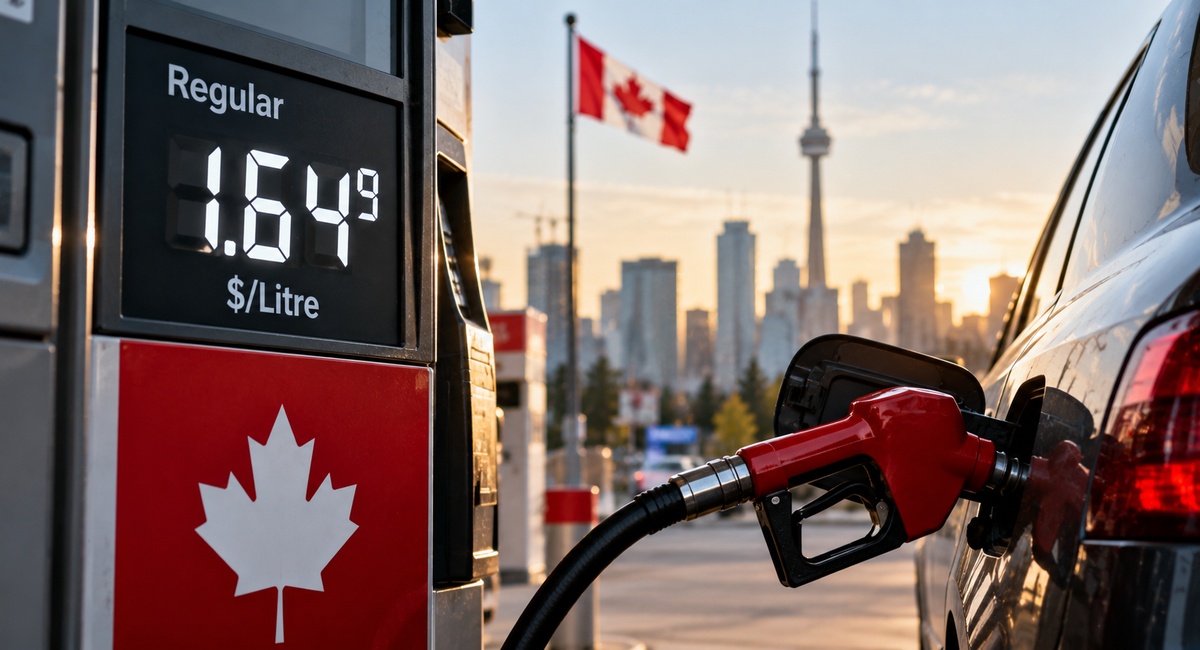
The September inflation report from Statistics Canada held two stories, and only one of them is visible from a car. Headline CPI rose 3.1% year over year, up from 3.0% in August and below the 3.2% consensus, while the Bank of Canada CPI-trim measure eased to 1.8%, its lowest reading since at least August 2025.
Gasoline prices rose 27.8% from a year earlier, up from 22.8% in August, and fuel oil and other fuels rose 57.8%. Excluding gasoline, consumer prices rose 2.2%. The distance between those figures is where behavioural finance does its work.
Why the Pump Price Outweighs the Core Measures
Amos Tversky and Daniel Kahneman showed in 1973 that people judge how large or how common something is by how easily examples come to mind. A gasoline price posted at every intersection is about as available as a price can be. Shelter prices, up 1.8%, and groceries, up 1.7% for the smallest annual increase since May 2024, leave no equivalent memory.
The inflation expectations literature points the same way. Francesco D'Acunto, Ulrike Malmendier, Juan Ospina and Michael Weber reported in the Journal of Political Economy in 2021 that household expectations follow the prices of the goods people buy most often. Olivier Coibion and Yuriy Gorodnichenko found in a 2015 American Economic Journal paper that household expectations respond strongly to gasoline price movements.
Salience compounds the effect. Pedro Bordalo, Nicola Gennaioli and Andrei Shleifer modelled in 2012 how decision makers overweight the attributes of a choice that stand out against the rest. Against a basket of price changes near 2%, a 27.8% move in a single item stands out.
What the Underlying Data Actually Shows
The Bank of Canada core measures describe a different economy. CPI-median slowed to 1.9% and CPI-trim to 1.8% in September. CIBC chief economist Avery Shenfeld told CBC News, "We have inflation in gasoline prices, which every Canadian already knew," and added that trend measures outside gasoline sit around 2%.
Headline CPI has risen 1.2 percentage points since August 2025 while CPI-trim has fallen by the same 1.2 points, and the two lines crossed in March, the first full month of the Iran war.
Headline CPI is the Statistics Canada year-over-year change; CPI-trim excludes components in the tails of the monthly price-change distribution. The Iran conflict began February 28, making March the first full month of its effect on fuel prices.
The crossover is the behavioural story in one picture. Headline CPI has now run above CPI-trim for seven straight months, March through September.
Where Perception Meets the October 28 Decision
The perception gap matters because the Bank of Canada decides on October 28 with its policy rate at 2.25%. Governor Tiff Macklem said over the weekend that sustained high energy prices will lift the Bank of Canada inflation forecast. BMO, Royal Bank of Canada and Desjardins moved Monday to calling for a quarter-point increase to 2.5%, while Michael Davenport of Oxford Economics judged the print slightly softer than he expected and saw better odds of a hold.
A second behavioural force sits behind the first. Prospect theory, set out by Kahneman and Tversky in 1979, holds that losses weigh more heavily than equivalent gains. The lowest insured five-year fixed mortgage rate stood at 4.34% on October 9, according to Ratehub, against five-year Government of Canada yields that were below 1% when millions of borrowers locked in during 2020 and 2021. The five-year yield closed at 3.54% on October 16, down from 3.69% on September 29.
In household accounting, that renewal loss and the gasoline signal can merge into a single feeling that prices are rising everywhere. Brent crude settled at $109.55 a barrel Monday, and Kpler data showed Gulf crude flows averaging about 8.5 million barrels per day last week, down from more than 20 million the week before. The input that sets the pump price has not eased.
How much of the 3.1% households treat as a budget problem, and how much as a forecast for the next twelve months, is the question the October 28 decision will put to the test.