
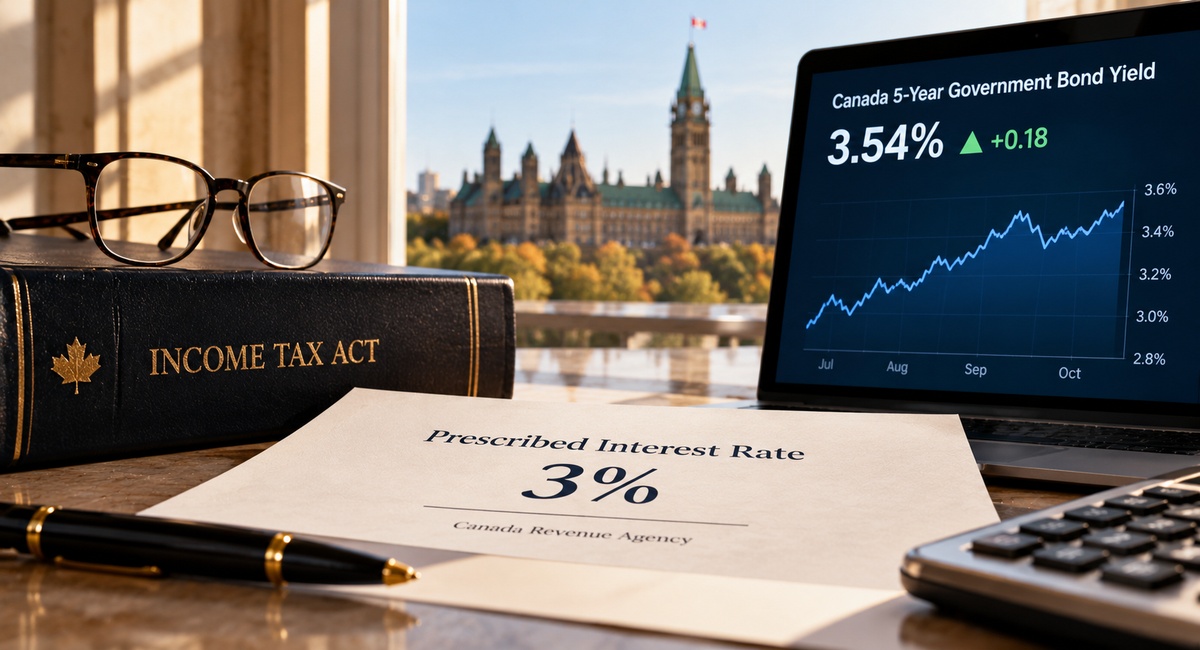
A prescribed rate loan opened before December 31 locks in a 3% borrowing rate for as long as the loan runs, and the five-year Government of Canada yield closed at 3.54% on October 16. That 54 basis point gap is the widest argument for family income-splitting loans in the past three years of the rate cycle shown below.
The Canada Revenue Agency left the prescribed rate at 3% for the fourth quarter, the sixth consecutive quarter at that level, according to Advisor.ca. The rate is set from the average three-month Treasury bill yield in the first month of the preceding quarter, rounded up to the next whole percentage. Bank of Canada data show three-month bills between 2.37% and 2.39% through the first half of October, which leaves 61 basis points before the next rounding threshold.
The Spread That Makes the Loan Work Again
At 6%, the rate in force in the first half of 2024, a prescribed rate loan needed a 6% return to leave the family ahead. At 3%, the five-year Government of Canada yield clears the hurdle by 54 basis points, and the ten-year yield of 3.84% clears it by 84 basis points, before any equity risk is taken.
The prescribed rate rose from 1% to 6% between the first half of 2022 and early 2024, then fell back to 3% by the third quarter of 2025 and has not moved since.
The prescribed rate is set each quarter from the average three-month Treasury bill yield in the first month of the preceding quarter, rounded up to the next whole percentage. The reference line marks the five-year Government of Canada benchmark yield on October 16, 2026.
Why a Prescribed Rate Loan Funds Only Non-Registered Accounts
A higher-income spouse or partner lends at the prescribed rate in force on the day the loan is made, and that rate stays fixed for the life of the loan. The lower-income spouse invests in a non-registered account and pays the interest no later than January 30 of the following year, every year. Registered accounts sit outside the strategy: TFSA income is already tax-free and RRSP growth is already deferred, so there is no taxable income for the loan to shift.
An illustration shows the mechanics. A $500,000 loan at 3% costs $15,000 a year in interest. A portfolio returning 5% earns $25,000, and the $10,000 spread is taxed to the lower-income spouse, while the $15,000 of interest is taxed to the lender and deductible to the borrower.
Incorporated clients sit differently. The loan comes from an individual with personal non-registered assets, so the first question is how much a client holds outside the corporation. The planning conversation is with couples where one partner is in a top bracket, the other has unused lower brackets, and non-registered assets held by the higher earner exceed those held by the lower earner.
The January 30 Payment and the December 30 Trade Date
Missing the January 30 interest payment is the one mistake the strategy does not forgive: the attribution rules then apply to the income from that year onward. Loans opened at 5% or 6% in 2023 and 2024 remain at those rates, and resetting means repaying the old loan and making a new one at the current rate, with attention to any gains realised to fund the repayment.
A second non-registered deadline is December 30, the approximate last trade date for losses to settle by December 31 under T+1, according to Raymond James. The 61-day superficial loss window applies across spouses and affiliated persons, which matters for any family running both a loan portfolio and a loss-selling plan. The capital gains inclusion rate remains 50% for individuals, corporations and trusts, so a realised loss offsets gains on the same basis.